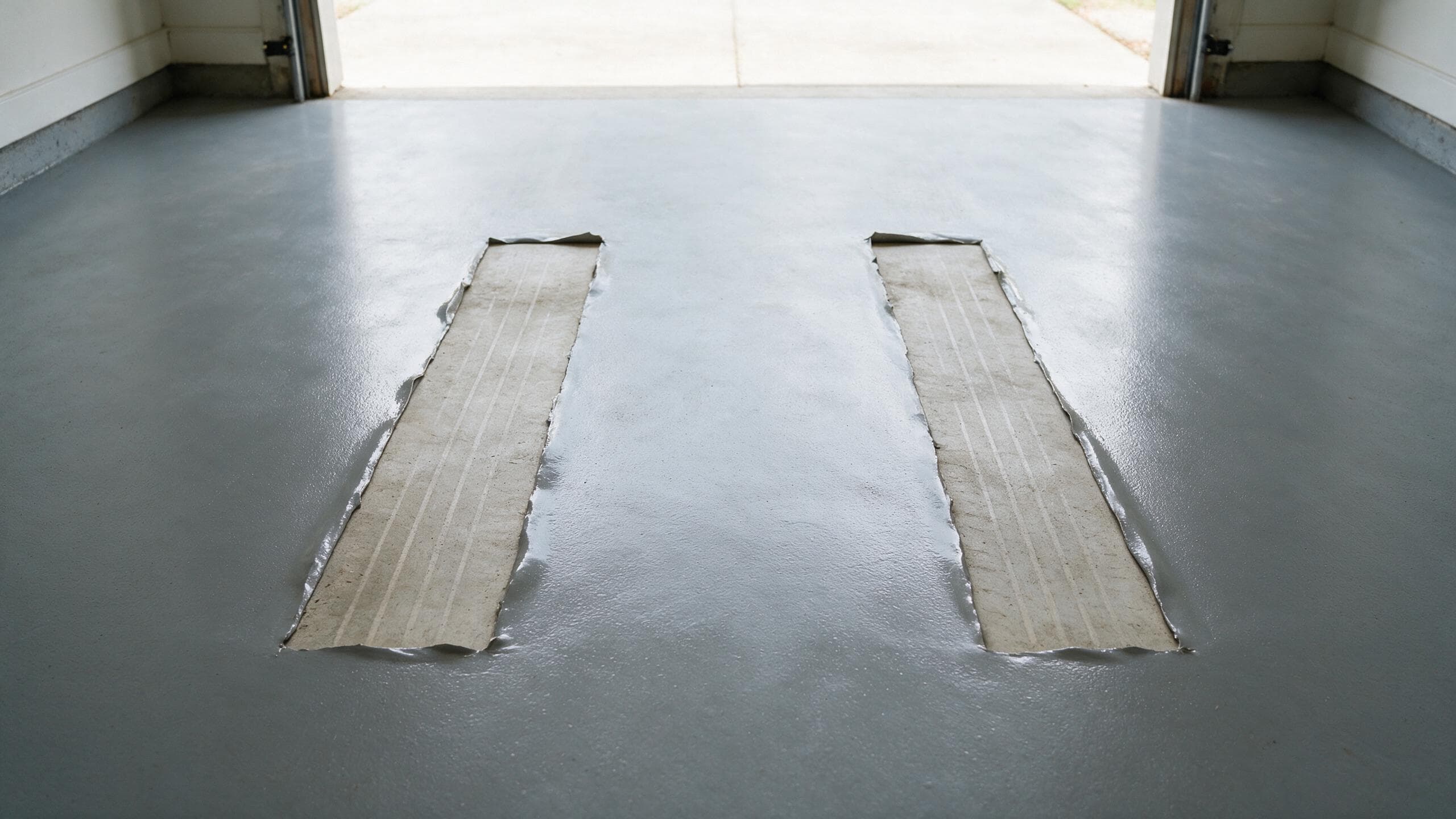
A tyre arrives hot off the road, softens the coating at its contact patch, and presses into it for hours while both cool. The rubber grips the softened film, and when the car pulls out the weaker of the two bonds lets go. On a properly ground floor that is the tyre. On an acid-etched or thin floor it is the coating, which comes away in a tyre-shaped patch. Heat is the trigger; preparation decides the outcome.
Why Charlotte Summers Make This Worse
Tyres do not simply match the air temperature. Flexing under load generates heat continuously, and dark asphalt in July radiates more into them. A tyre coming off Interstate 485 on a hot afternoon arrives at your garage well above the ambient temperature of the air around it, and it holds that heat for a considerable time after the engine stops.
It then transfers that heat into a contact patch roughly the size of a hand, under several hundred pounds of static load, for as long as the car sits. Coatings soften as they warm. Standard epoxy softens meaningfully at the temperatures involved, and a softened film is exactly what warm rubber will key into as it cools and contracts.
The result is a competition between two bonds: rubber-to-coating, and coating-to-concrete. Every part of the process is normal and unavoidable except the last one. Whether you lose a patch of floor depends entirely on whether the coating is better attached to the slab than the tyre is to the coating.
Risk by System
| System | Film Build | Risk | Notes |
|---|---|---|---|
| DIY big-box kit | 2–3 mils | Very high | Soft film over etched concrete |
| Solid color epoxy, no topcoat | 15–25 mils | High | Epoxy softens at tyre temperature |
| Flake epoxy + urethane top | 20–30 mils | Moderate | Better heat tolerance than bare epoxy |
| Flake epoxy + polyaspartic top | 25–40 mils | Low | Charlotte residential standard |
| Full polyaspartic system | 25–40 mils | Very low | Holds hardness at temperature |
Every row assumes diamond-ground preparation. Over an acid-etched slab, move every system up at least one risk level.
Five Ways to Prevent It
Diamond grind, which decides everything else
Hot tire pickup is a bond failure. A coating keyed properly into an opened slab has adhesion strength far beyond what a cooling tyre can apply, so the rubber releases from the coating rather than the coating releasing from the concrete. On an acid-etched floor that comparison runs the other way, and heat is simply the trigger that reveals it.
Specify a UV-stable polyaspartic topcoat
The topcoat is the layer that meets the tyre. Polyaspartic retains hardness at elevated temperature where epoxy softens, which removes most of the mechanism. This is the single most effective product-level defence and it is why it is our default specification for Charlotte garages rather than an upsell.
Build real film thickness
A 25 to 40 mil system has structural depth. A 3 mil film has none, so any local bond weakness becomes a lift point immediately. Thickness will not rescue bad preparation, but thin film makes marginal preparation fail much sooner.
Respect the full cure before parking
A coating reaches surface hardness days before it reaches full chemical cure, and parking during that gap is hot tire pickup on an accelerated schedule. Wait 24 hours on a full polyaspartic system and 72 or more on standard epoxy, longer in cold weather. This is the most avoidable version of the problem and we still see it every year.
Let hot tyres cool, or put a mat down
Cheap insurance on an existing floor you are not planning to replace. Leaving the garage door open for a few minutes after a summer drive lets tyre temperature drop before the car sits. A breathable mat under the parking position removes the contact entirely. Avoid solid rubber-backed mats, which trap moisture and can mark a coating on their own.
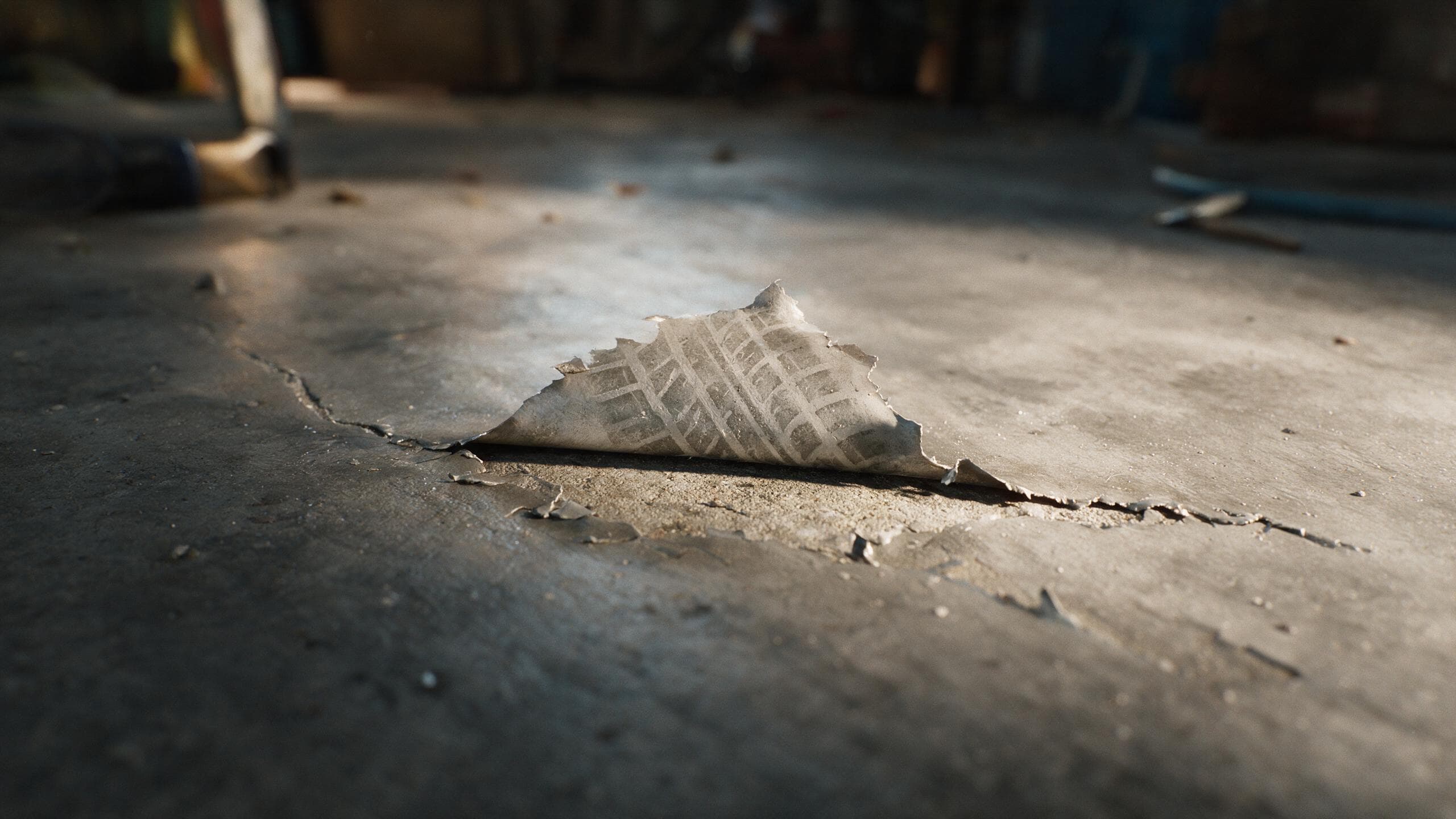
Tread pattern visible in the lifted film. That impression is the proof of mechanism rather than ordinary wear
If It Has Already Happened
Before repairing anything, find out whether the damage is local or the first symptom of a floor that is coming off. Tap across the surrounding coating with something hard and listen. A sharp tap means it is bonded. A hollow sound means it has already released and simply has not lifted yet.
If the floor around the damage sounds solid, the affected area can be ground back to concrete, feathered into the sound edge, and recoated. It is a genuine repair and it holds. If tapping turns up hollow areas spreading outward, patching is wasted money, because the patch will lift along a new edge in the next warm spell. That floor needs stripping and replacing, and the underside of a lifted piece will tell you whether preparation or moisture caused it.
Either way, resist the urge to recoat over the damage without grinding. Coating over a surface that has just demonstrated it cannot hold a coating produces the same result on a delay.
Lost a patch of floor where you park? We will tell you whether it is a local repair or the start of a full failure, and we will say so plainly when it is the cheaper answer. Free across the Charlotte metro.
Get Free EstimateFrequently Asked Questions
Related Guides
Share this guide: