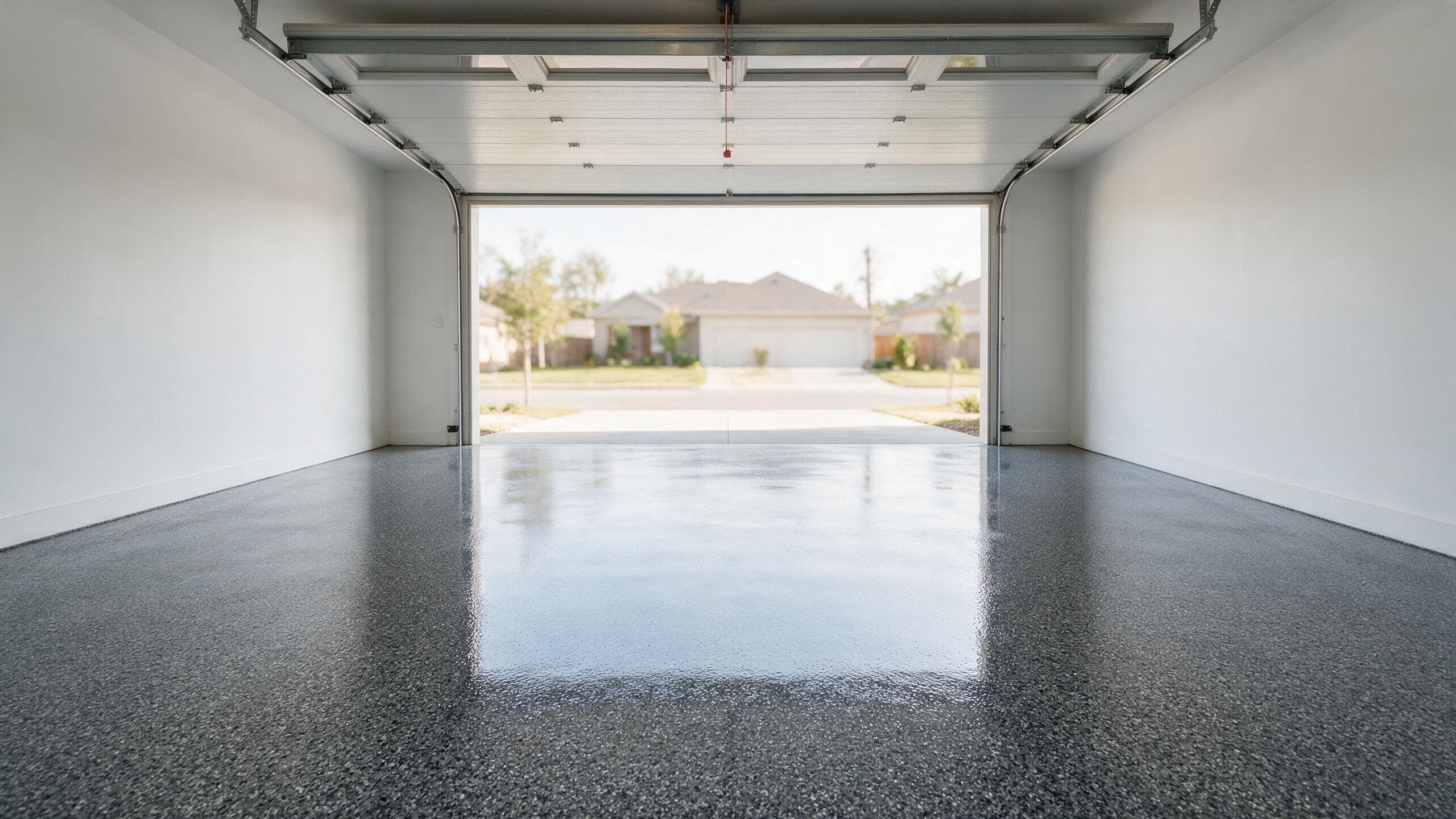
On a full polyaspartic system you can park after 24 hours. On a standard epoxy system, wait 72 hours at minimum and 5 to 7 days in cold weather. Foot traffic comes far sooner in both cases. The number that catches people out is the one in between: a floor that feels completely hard underfoot can still be days away from taking a vehicle.
Cure Times by System
| System | Foot Traffic | Vehicles | Full Cure | Mats Down |
|---|---|---|---|---|
| Full polyaspartic | 4–6 hours | 24 hours | 3 days | 3 days |
| Flake epoxy + polyaspartic top | 8–12 hours | 24–48 hours | 5 days | 5 days |
| Flake epoxy + urethane top | 12–24 hours | 72 hours | 7 days | 7 days |
| Solid color epoxy | 12–24 hours | 72 hours | 7 days | 7 days |
| DIY big-box kit | 24–48 hours | 5–7 days | 14 days | 14 days |
Figures assume a Charlotte garage at 60–85°F. Below 50°F, add 40 to 100% to every epoxy column. Polyaspartic changes very little with temperature.
Hard to the Touch Is Not the Same as Cured
This distinction is the whole article really. A coating reaches most of its surface hardness quickly, then keeps cross-linking chemically for days afterward. Somewhere between those two points the floor stops feeling tacky, looks finished, and will happily take your body weight without marking. It is not yet capable of taking a vehicle.
The reason is contact pressure. A person spreads roughly 150 pounds across two shoe soles. A car concentrates around 900 pounds into four contact patches the size of a hand, and it holds that load in one place for hours at a time. A partially cured film deforms under sustained point loading in a way it never would under someone walking across it, and once it takes that impression the impression is permanent.
Charlotte adds heat to the equation. A tyre that has been on Interstate 485 in July arrives at the garage far hotter than the air, and warm rubber against a coating that has not finished cross-linking can bond to the surface. When the car pulls out days later, a patch of floor comes with it. That is hot tyre pickup, and it is the failure mode we most often get called out to fix on floors that were driven on too early.
Five Ways People Damage a New Floor in Week One
Parking at 48 hours because it feels hard
Hard to the touch is not cured. An epoxy floor reaches most of its surface hardness well before it reaches full chemical cure, and the gap between those two points is exactly where the damage happens. The floor will take a footprint fine and still deform under 900 pounds of tyre contact pressure.
Pulling in hot off Charlotte asphalt
Summer tyres arrive at the garage well above ambient temperature. Against a coating that has not finished curing, hot rubber can bond to the film and lift it when the vehicle moves off. This is hot tyre pickup happening on day three rather than year three, and it is entirely avoidable by waiting.
Laying cardboard or mats down early
People protect a new floor by covering it, which traps the solvent still releasing from the coating. The result is discolouration, soft patches, and sometimes a permanent imprint of whatever was laid down. Leave the surface open to the air for the full cure window.
Rolling a heavy toolbox across at day four
Point loading from castor wheels concentrates far more pressure per square inch than a tyre does. A loaded rolling chest can score a green coating badly enough to need a spot grind. Wait out the full cure before anything with small hard wheels goes back in.
Assuming winter timings match summer ones
A Charlotte install in November and one in July are not the same job. Epoxy cure time roughly doubles for every 18°F drop, so the 72 hour figure becomes 5 to 7 days in an unheated garage in January. Ask the installer for the timings for your install date rather than the ones on the tin.
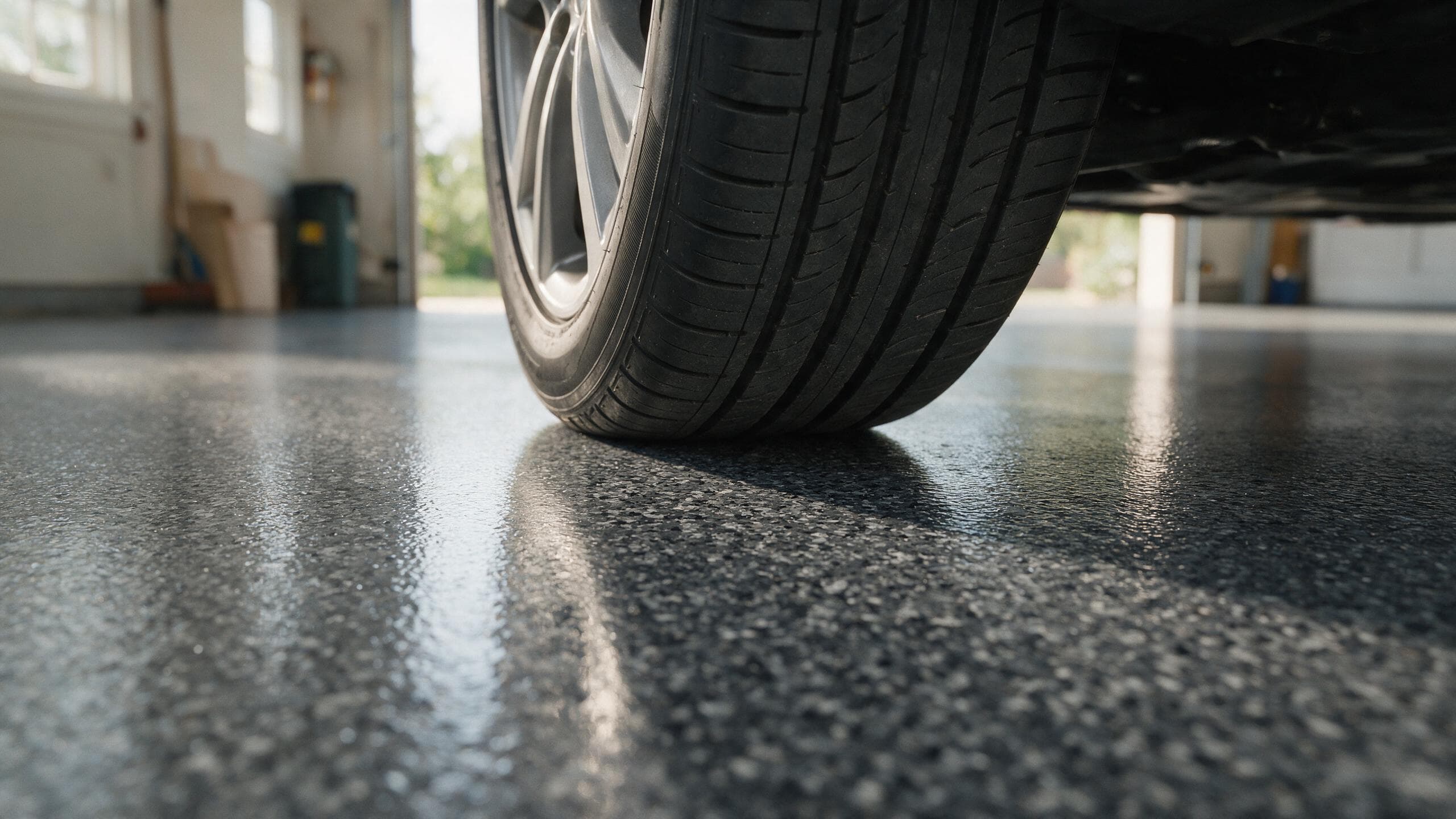
A Mint Hill garage back in full service. Once through the cure window, a professionally installed floor takes daily vehicle traffic without complaint
Why the One-Day System Exists
Cure time is the practical reason polyaspartic took over the residential garage market here. The finished floors are comparable in appearance, and both look excellent. The difference is that an epoxy install costs you most of a week of garage access while a polyaspartic install costs you a day.
For a household with two cars and one garage in Charlotte, that week means parking on the street or the driveway through whatever weather arrives, moving everything that was stored in the garage twice, and working around a project that is technically finished but not usable. None of it appears on the quote, and it is a real cost.
If timing is the constraint, say so at the estimate. On a garage where the slab reads dry and the schedule is tight, a full polyaspartic system at $7–12 per square foot gets you grinding in the morning and parking the following day.
Need the garage back fast? Tell us the date you need to park and we will tell you honestly which system makes it and which does not. Free estimates across the Charlotte metro.
Get Free EstimateFrequently Asked Questions
Related Guides
Share this guide: