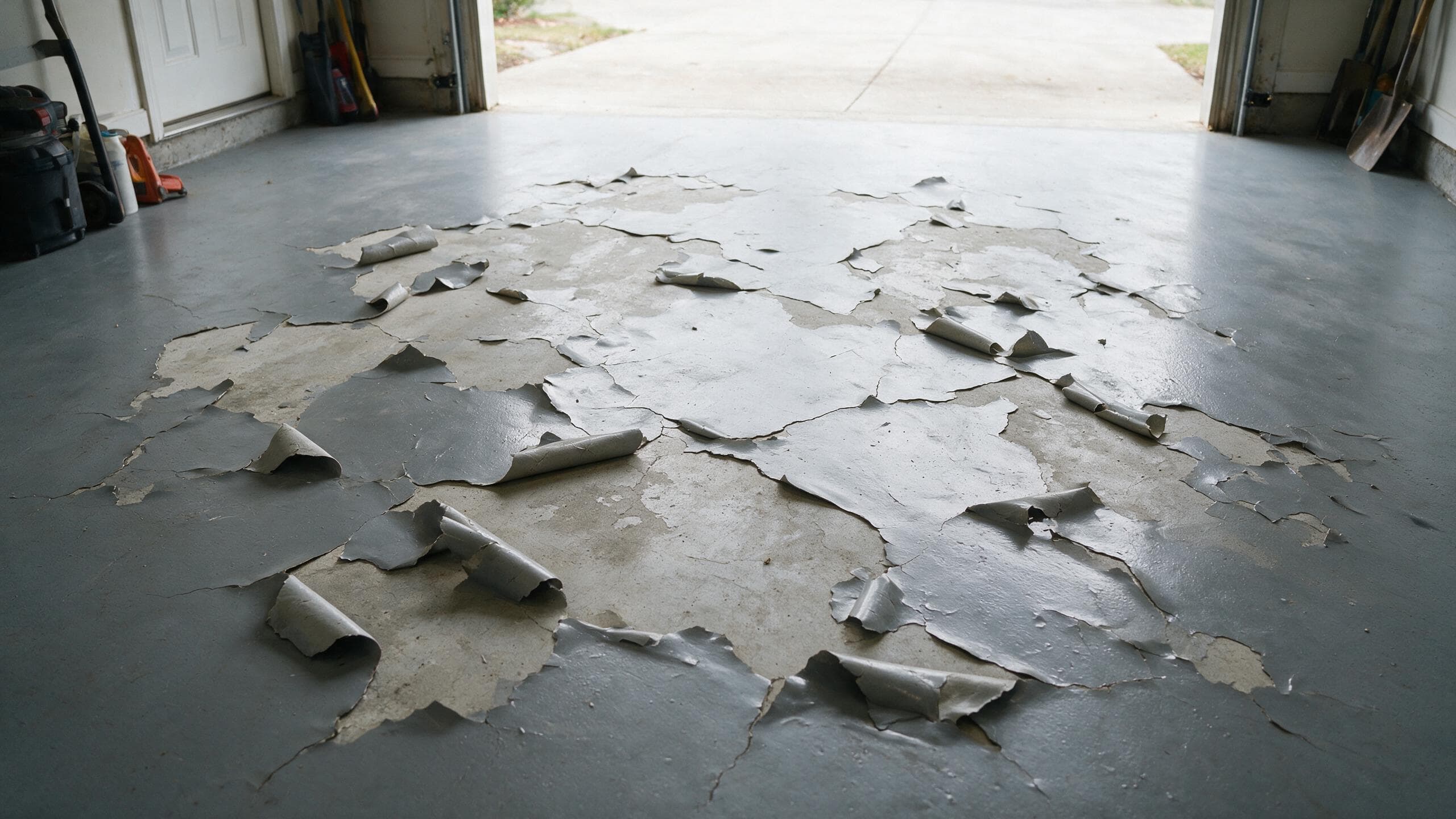
Almost always preparation. Acid etching instead of diamond grinding is the leading cause by a wide margin, followed by untested slab moisture pushing the coating off from underneath. You can tell which one you have in about ten seconds: pick up a lifted piece and look at the back. Clean and glossy means it never bonded. Concrete stuck to it means the bond held and the slab gave way.
Step One: Read the Underside
Everything about the repair depends on which of two failures you have, and the top of the floor tells you almost nothing. Lift a loose piece, turn it over, and look at the face that was against the concrete.
Clean, glossy underside
No concrete attached at all. The coating never keyed into the slab, so this is a preparation failure: etching rather than grinding, or coating over a sealer. The slab below usually looks smooth and closed rather than opened up.
Concrete stuck to the back
A thin layer of slab came away with the coating. The bond was fine and the concrete surface failed instead, which points to vapour pressure from below or a weak laitance layer. This one needs moisture testing before anything is recoated.
Then find the full extent. Tap across the surrounding floor with a hard object and listen: sound coating gives a sharp tap, debonded coating sounds hollow. Delamination almost always reaches well past what is visibly lifted, and treating only the obvious area is the most common reason a repair fails again along a new edge.
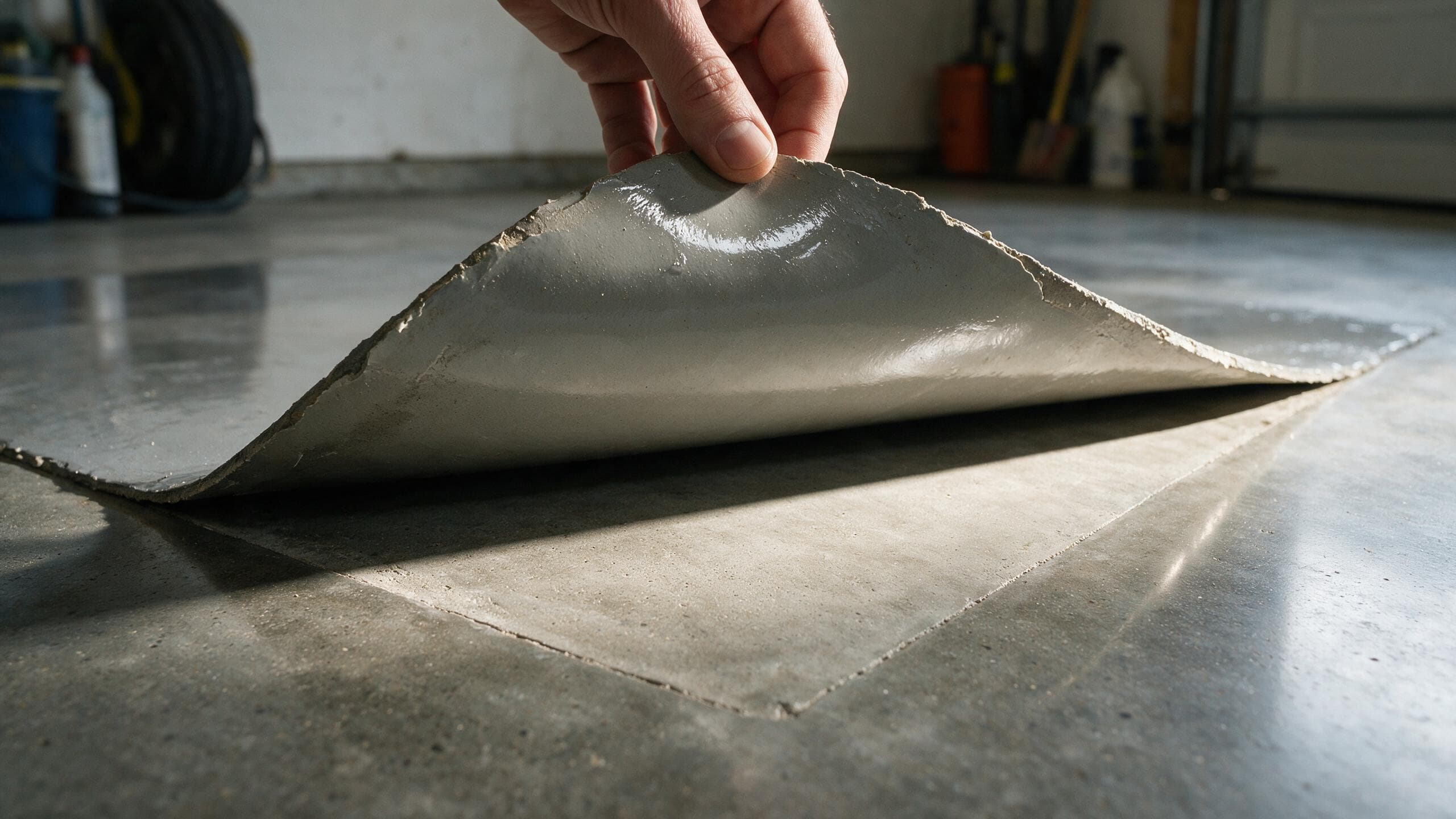
A clean release. No concrete on the back of the coating and no profile on the slab below, which is what an etched rather than ground floor looks like
The Five Causes, in Order of How Often We See Them
Acid etching instead of diamond grinding
The single largest cause and it is not close. A garage slab is power-troweled to a hard, tight, nearly closed surface. Acid cleans that surface but does not open a mechanical profile in it, so the coating is essentially glued to glass. Floors prepared this way frequently begin lifting inside two years no matter how good the resin was. The underside of a lifted piece comes away clean and glossy.
Slab moisture that was never measured
Piedmont clay holds water against foundations for days after rain, and that water moves up through the slab as vapour. The pressure lifts coatings from beneath regardless of how well the surface was prepared. The signature is different from a prep failure: pieces come up with concrete bonded to the back, because the coating held and the top of the slab let go. Diagnosis requires in-slab probes, not a surface meter.
Coating applied over an existing sealer
A sealer works by occupying the pore structure of the concrete, which is exactly where a coating needs to key in. Many Charlotte builders seal garage slabs at handover and nobody records it. The result looks identical to a prep failure because functionally it is one, and the fix is the same: grind everything off and start from open concrete.
Contamination that survived cleaning
Oil and transmission fluid soak deep into bare concrete and wick back to the surface during cure, breaking the bond in patches rather than across the whole floor. Isolated round failures under where a vehicle parked, with sound coating everywhere else, usually mean contamination rather than global prep failure. Degreasing alone does not reach it; the affected concrete has to be ground out.
Film too thin to survive anything
A consumer kit lays down 2 to 3 mils against 20 to 40 for a professional system. At that thickness there is no build to absorb abrasion, so the film is breached at the tyre path early, water gets underneath, and the failure spreads outward from the breach. This one usually looks like wear that turned into peeling rather than peeling that started on its own.
The Charlotte-Specific Part: Slab Moisture
Piedmont clay drains slowly and holds water against foundations for days after heavy rain. That water does not sit still. It moves up through the slab as vapour, and vapour under a sealed film exerts real pressure on the bond line. On a floor that was otherwise well installed, this is the failure that gets it.
It cannot be judged by looking, and a surface meter will not answer it either, because a surface reading describes this morning rather than what the slab does in February. The measurement that matters is internal relative humidity, taken with probes set into drilled holes and left to equilibrate. Above roughly 75 to 80 percent, a moisture-mitigating primer is required before any coating goes down, at $0.50–0.75 per square foot.
Slabs on sloped lots, below surrounding grade, or with poor perimeter drainage read high more often. So do slabs poured within the last year, which are still giving up water from the original mix. If your floor failed and nobody drilled a probe into it before quoting the replacement, that is the question to ask the next contractor.
The Repair, Step by Step
Remove everything that has failed. Not the visible patches, the full hollow-sounding extent. Coating that is releasing but has not lifted yet will release later, and anything bonded to it goes with it.
Diamond grind the whole area to a consistent profile. This is the step that decides whether the second floor lasts. Grinding opens the concrete and removes the closed troweled surface, the laitance layer, and any residual sealer or contamination in one operation. Etching does not do this, which is why the first floor failed.
Test slab moisture before specifying anything. Probes in, left to equilibrate, read properly. This is also the moment to find out whether the failure was moisture-driven in the first place.
Repair cracks and joints, prime if required, then recoat to full thickness. Cracks get filled and joints get an appropriate filler rather than being bridged with coating, which only cracks again along the same line. Where the moisture reading calls for it, a mitigating primer goes down first. Then the replacement system at its full specified build, 20 to 40 mils rather than whatever the previous installer managed.
Expect $6–10 per square foot for removal and replacement, roughly $2,700 to $4,500 on a 450 sqft two-car garage. The grinding cost to take off the failed system is the part that stings, and it is unavoidable. Our residential installations carry a written lifetime warranty against delamination, which is the whole reason the preparation above is not negotiable.
Send a photo of a lifted piece, underside up, and we will tell you which failure you are looking at before anyone quotes you. We assess failed floors across the Charlotte metro free, including ones other contractors installed.
Get Free EstimateFrequently Asked Questions
Related Guides
Share this guide: