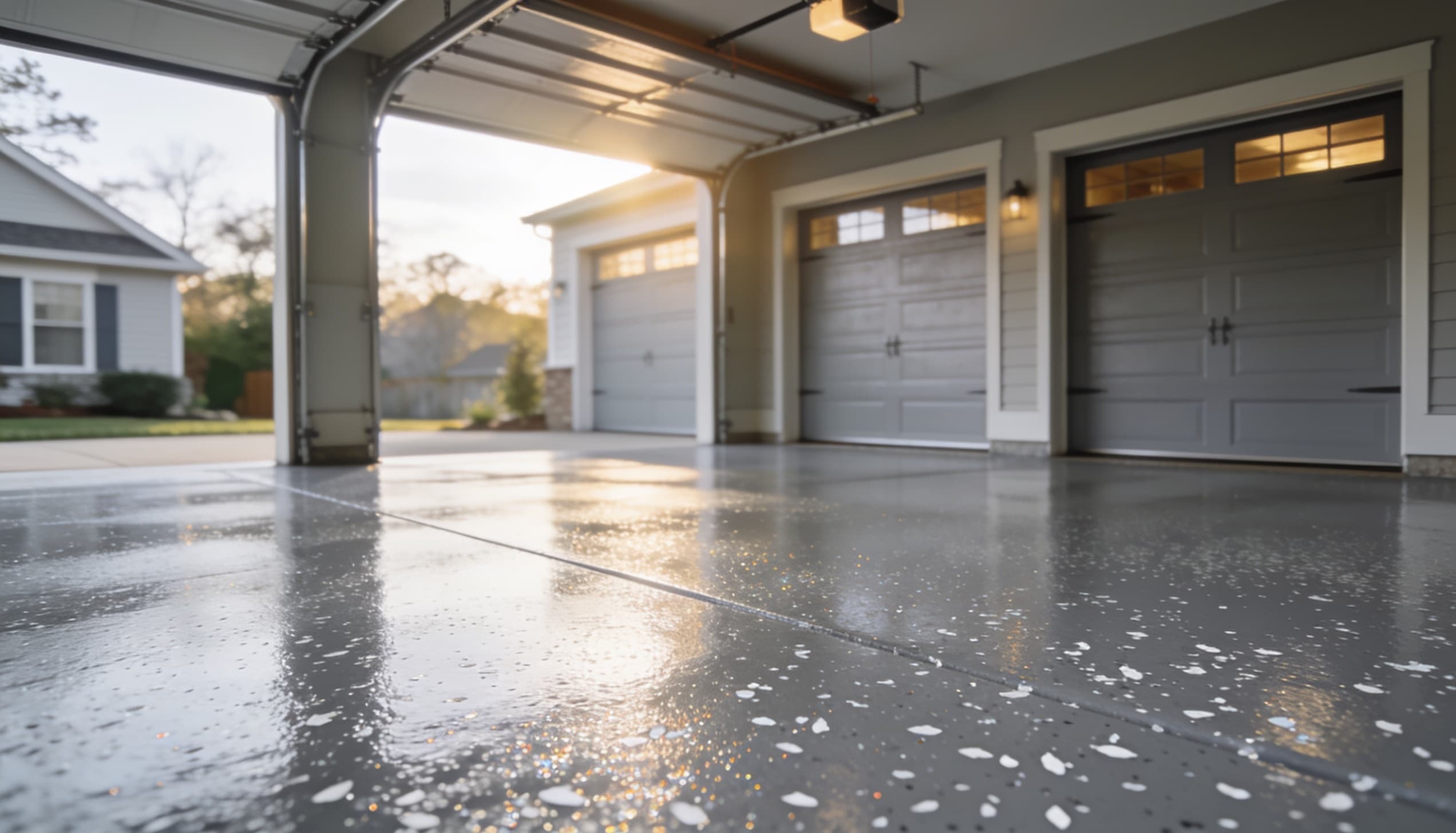
A professionally installed epoxy garage floor lasts 10–15 years in Charlotte. A full polyaspartic system lasts 15–20. A big-box DIY kit lasts 1–3. The gap between those numbers is not resin quality — it is almost entirely surface preparation and film thickness, both of which are decided before a single drop of coating is applied.
Lifespan by System — Charlotte Garages
| System | Lifespan | Film Build | Notes |
|---|---|---|---|
| Big-box DIY kit | 1–3 years | 2–3 mils | Acid-etch prep, minimal build |
| Solid color epoxy (pro) | 8–12 years | 15–25 mils | Shows wear at tyre paths first |
| Flake epoxy + polyurethane top | 10–15 years | 20–30 mils | Charlotte residential standard |
| Flake epoxy + polyaspartic top | 12–18 years | 25–40 mils | UV-stable, resists hot tyre pickup |
| Full polyaspartic system | 15–20 years | 25–40 mils | Longest service life available |
| Metallic epoxy + polyaspartic | 10–15 years | 25–40 mils | Wears like flake, shows scratches sooner |
Lifespans assume diamond-ground preparation and normal residential use. A mil is one thousandth of an inch — a consumer kit at 3 mils is roughly the thickness of a sheet of paper.
Five Things That Shorten a Floor's Life
Acid etching instead of grinding
The number one cause of early failure by a wide margin. Etching cleans but does not create the mechanical profile a coating keys into on a hard-troweled garage slab. A floor that was etched rather than ground is often lifting within two years no matter how good the resin was.
Untested slab moisture
Charlotte clay holds water against foundations. Vapour drives up through the concrete and pushes the coating off from beneath. Slab relative humidity has to be measured before coating, and a moisture-mitigating primer specified where the reading calls for it.
Insufficient film thickness
A 2–3 mil consumer kit has nothing to give up to abrasion. Once the film is breached at the tyre path, water gets underneath and the failure spreads outward from there.
Hot tyre pickup
A Charlotte-specific accelerator. Tyres off summer asphalt land hot on the floor; a coating without a UV-stable, heat-tolerant topcoat can bond to the rubber and lift when the vehicle moves.
Abrasive grit left on the surface
The least dramatic and most common wear mechanism. Sand and grit ground under tyres act like sandpaper. Sweeping is genuinely the highest-leverage maintenance there is.
What Our Warranty Actually Covers
A warranty is only as useful as the failure mode it covers, so here is ours in plain terms. Residential installations are warranted for life against delamination and peeling — the coating separating from the concrete. Commercial installations carry a 5-year workmanship warranty on adhesion. The document is written, handed over at project completion, and specifies the installation address and claim contact.
It transfers automatically if you sell the house, because the warranty is attached to the installation rather than to you. Charlotte agents routinely include the documentation in disclosure packets.
Covered
- + Delamination from the slab
- + Peeling and lifting
- + Adhesion failure at the bond line
- + Normal wear, cleaning, and vehicle traffic do not affect coverage
Not covered
- − Physical damage — impact, gouging, dropped tools
- − Another coating applied over ours
- − Structural slab movement beyond normal settlement
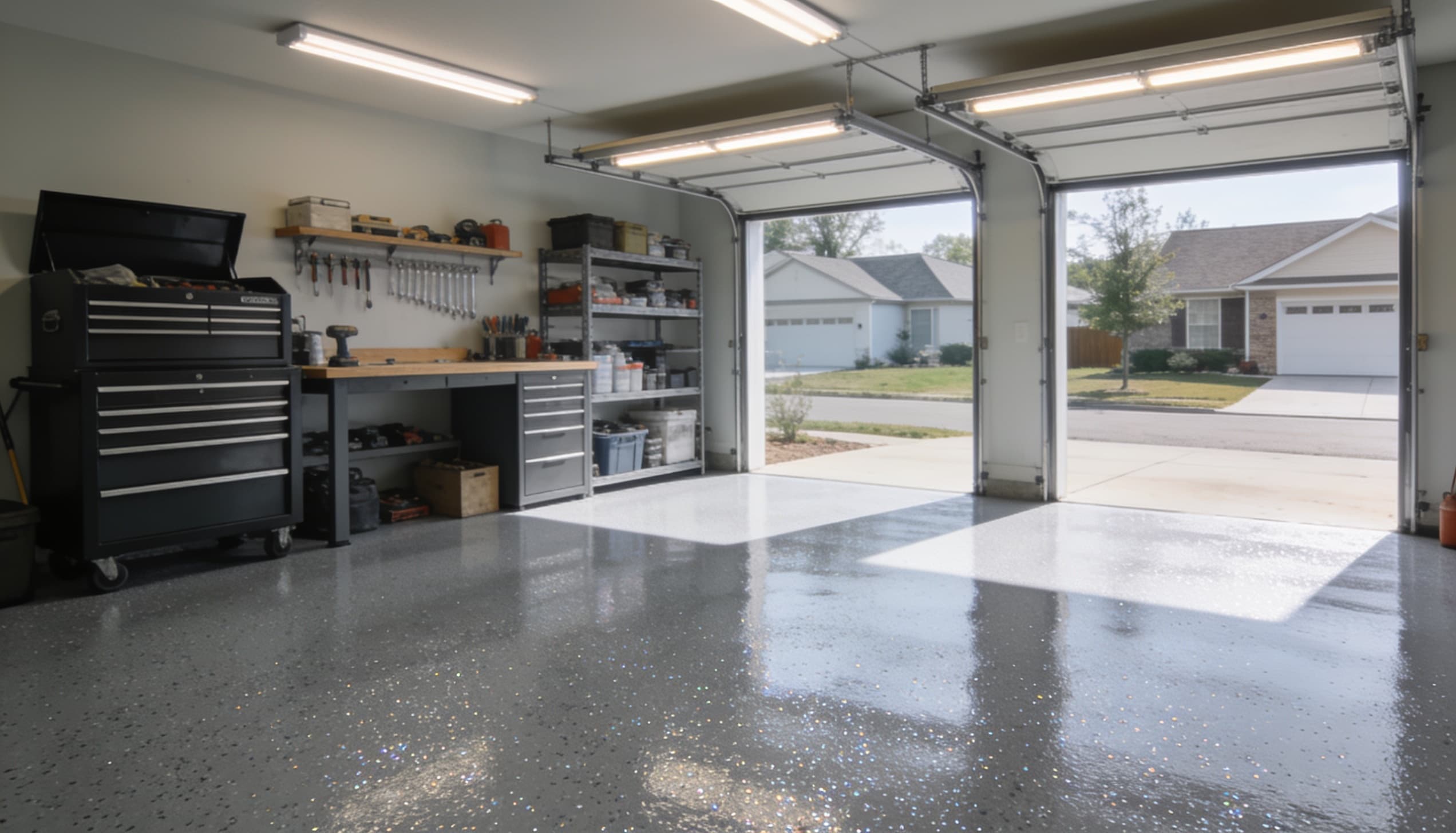
A working Charlotte metro garage — tool chests, rolling storage, and daily use are exactly what these systems are specified for
Getting the Long End of the Range
The difference between a floor lasting ten years and eighteen is mostly grit. Sand and dirt tracked in on tyres get ground into the surface every time you pull in or out, and that abrasion is the dominant wear mechanism on a residential floor — more than chemicals, more than impact. A broom, used regularly, is genuinely the highest-return maintenance available.
Beyond that: clean with a pH-neutral product rather than a degreaser, put a mat under any vehicle that drips, lift toolboxes and jack stands rather than dragging them, and rinse road salt off in winter. None of that is demanding, and together it comfortably buys years.
The last piece is timing the refresh. When gloss starts dulling in the tyre paths, that is the topcoat wearing — not the system failing. Recoating at that point runs roughly $1.50–$2.50 per square foot and resets the clock. Wait until the wear breaks through to the base coat and you are looking at a full grind and replacement instead.
Have a coating that is starting to lift, dull, or peel? We assess whether it needs a topcoat refresh or a full strip and rebuild — and we will tell you if it is the cheaper option. Free across the Charlotte metro.
Get Free EstimateFrequently Asked Questions
Related Guides
Share this guide: