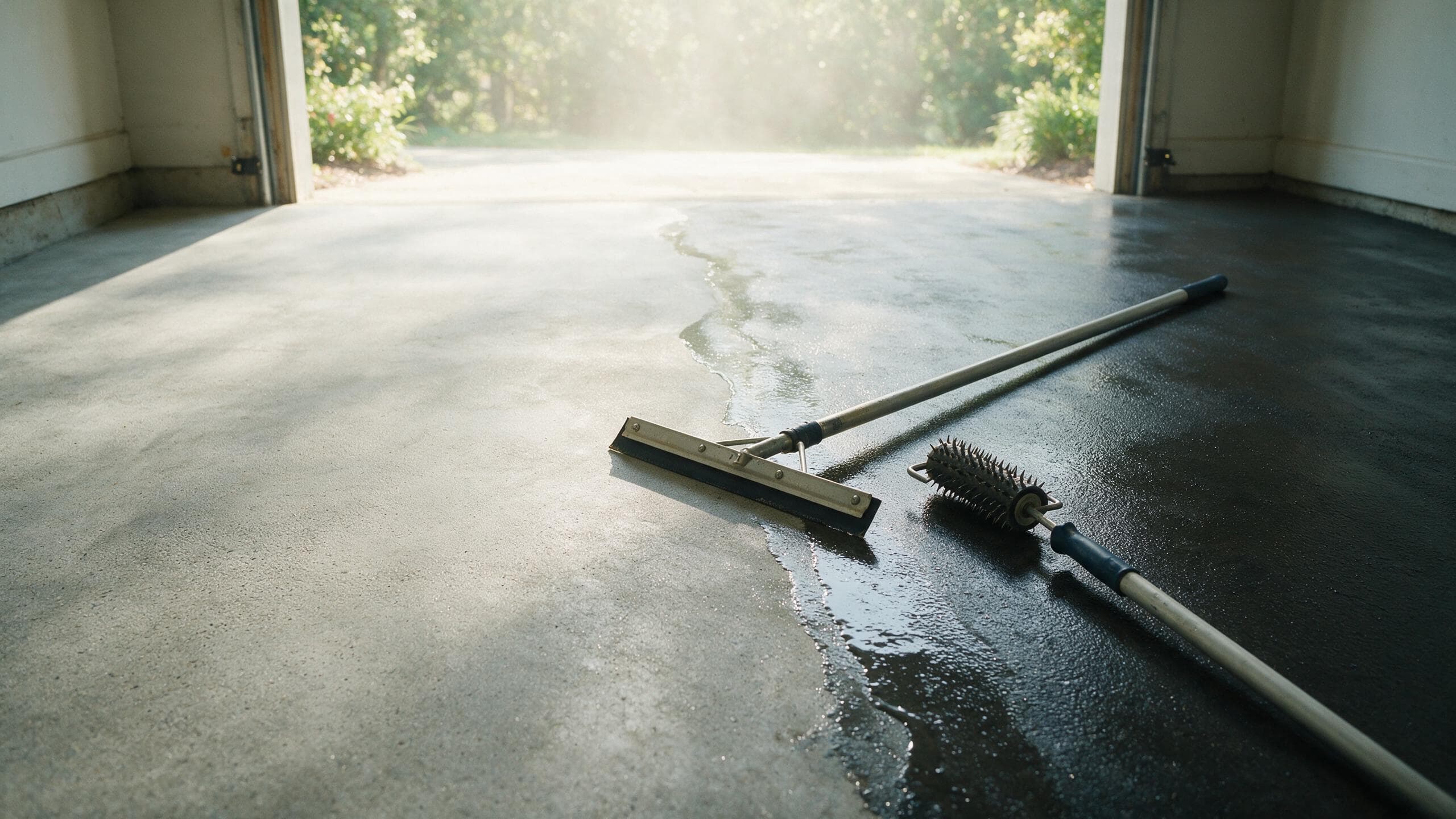
Carolina humidity does not stop a polyaspartic install. Polyaspartic is moisture-cured, so ambient humidity accelerates the reaction rather than blocking it, and a 90% relative humidity July morning in Charlotte is a normal working day. The two things that genuinely stop a job are dew point and slab moisture, and neither is visible from the weather app.
Humidity Speeds Polyaspartic Up, Not Down
This is the part that runs against intuition, and it is where most of the confusion comes from. Epoxy cures through a reaction between two components, and ambient moisture interferes with it: coat an epoxy floor on a damp morning and you can get a hazy, greasy-looking surface called amine blush. Polyaspartic works differently. It draws moisture out of the air as part of curing, so higher humidity makes it set sooner.
On a mild spring day in Charlotte a polyaspartic coat stays workable for roughly 60 to 90 minutes. On a humid August afternoon at 90°F that window can close inside 45. Nothing about the finished floor is worse for it. What changes is the installation rhythm: batches get smaller, sections get narrower, and the crew moves faster. A team that installs here year-round has this reflex. A team that does not can leave roller marks and cold joints where material set before it was worked out.
The practical takeaway for a homeowner is narrow but useful. Humidity is not a reason to delay a polyaspartic install in Charlotte, and a contractor who tells you to wait until autumn for humidity reasons is describing an epoxy constraint, not a polyaspartic one.
What Actually Stops an Install
| Condition | Threshold | Call | Why |
|---|---|---|---|
| Ambient relative humidity | 30–90% | Install proceeds | Polyaspartic cures with moisture, not against it |
| Slab surface vs dew point | Within 5°F | Stop | Condensation forms on the slab and kills adhesion |
| Slab internal RH | Above 75–80% | Primer required | Moisture-mitigating primer before any coating |
| Slab temperature | Below 0°F | Stop | Rarely a Charlotte concern, unlike epoxy at 50°F |
| Standing water or active seepage | Any | Stop | Source has to be fixed before coating |
Every one of these is measured on site on the morning of the install. None of them can be judged from a forecast.
The Dew Point Rule That Rules Out Mornings
A concrete slab holds temperature far longer than the air above it. On a July morning in Charlotte the air warms quickly while the slab stays cool from overnight, and when the slab surface sits within about 5°F of the dew point, moisture condenses on the concrete. It is often invisible. The floor looks dry, feels dry, and has a microscopic film of water across it that any coating will fail to bond through.
That failure does not show up on install day. It shows up eight or eighteen months later as a patch that lifts cleanly away from the slab with no coating residue left behind, which is the signature of a bond that never formed. This is why we carry a surface thermometer and check dew point before the grinder comes off the truck, and why a summer install here sometimes starts at eleven rather than seven.
If you are comparing quotes, this is a fair and revealing question to ask: what is your dew point rule, and what do you do if the slab fails it on the morning? A crew that has a specific answer has done this in Carolina summers. A crew that has never considered it is telling you something useful.
How We Install Through a Charlotte Summer
Slab moisture test before anything else
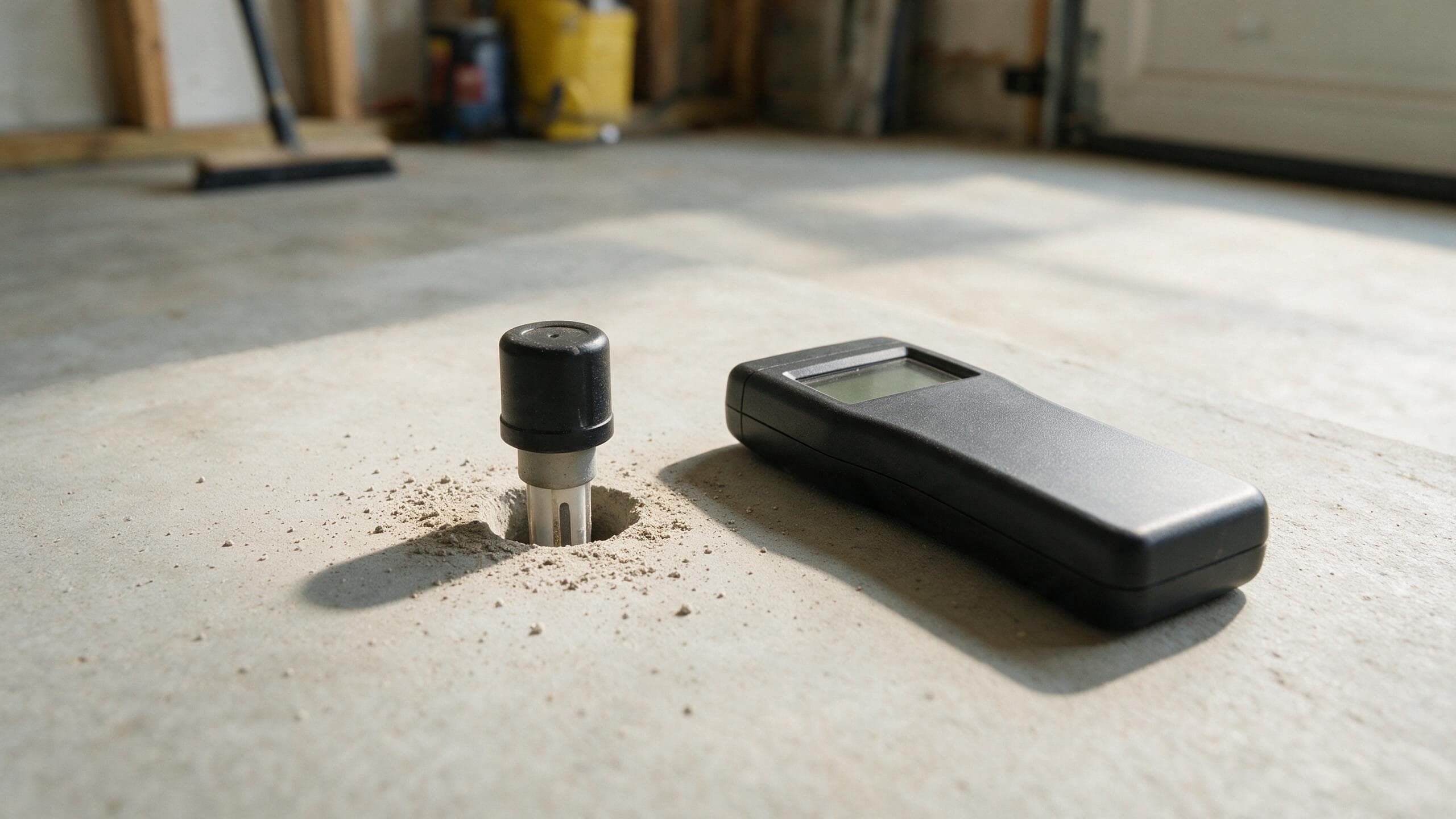
We take internal relative humidity readings with in-slab probes, not a surface meter. Surface readings tell you about this morning. Probe readings tell you what the slab will be doing in February. On Charlotte clay lots the two disagree often enough that we stopped trusting surface readings years ago.
Dew point check on the morning of the install
Slab surface temperature and dew point both get measured on arrival. If the slab sits within 5°F of the dew point there is invisible condensation on the concrete, and any coating applied over it will release later. This single check rules out more Charlotte summer mornings than high humidity ever does.
Diamond grinding, never acid etching
Grinding opens the concrete to a consistent profile and removes the sealed surface layer. Acid etching leaves a residue that traps moisture underneath and gives a weaker mechanical key. On a humid slab the difference between the two shows up within a couple of years.
Smaller batches, tighter sections
At 85% humidity and 90°F the pot life shortens considerably. We mix less material at a time and work narrower sections so nothing sets before it is spread and broadcast. This is the practical adjustment humidity forces, and it is about crew rhythm rather than product choice.
Moisture-mitigating primer where the readings call for it
Where slab RH comes back above 75 to 80%, a primer designed to hold back vapour pressure goes down first at $0.50–0.75 per square foot. It is not a universal add-on. It is specified from the reading, which is why the reading has to happen before the quote is final.
A Waxhaw garage finished in mid-summer. Humidity affected the schedule on the day and nothing about the result
The Piedmont Clay Problem Underneath
Ambient humidity is a scheduling variable. Slab moisture is a structural one, and in this region it is the more important of the two by a wide margin. Piedmont clay drains slowly and holds water against foundations for days after heavy rain. That water moves up through the slab as vapour, and vapour pressure lifts coatings off from beneath no matter how well the surface was ground.
You cannot see it and you cannot feel it. It is measured with probes set into the slab, left to equilibrate, and read as internal relative humidity. Above roughly 75 to 80% we specify a moisture-mitigating primer before any coating goes down, at $0.50–0.75 per square foot. Below that threshold we do not, and we say so rather than adding it to every quote.
Garages built on a slope, on a lot with poor drainage, or below the level of the surrounding grade read high more often. So do newer slabs: concrete poured within the last twelve months is still giving up water from the mix itself, which is a separate issue from ground moisture and one reason a brand new build sometimes has to wait.
We test slab moisture at the estimate, not after the deposit, so the primer line either appears on your quote with a reading behind it or does not appear at all. Free across the Charlotte metro.
Get Free EstimateFrequently Asked Questions
Related Guides
Share this guide: