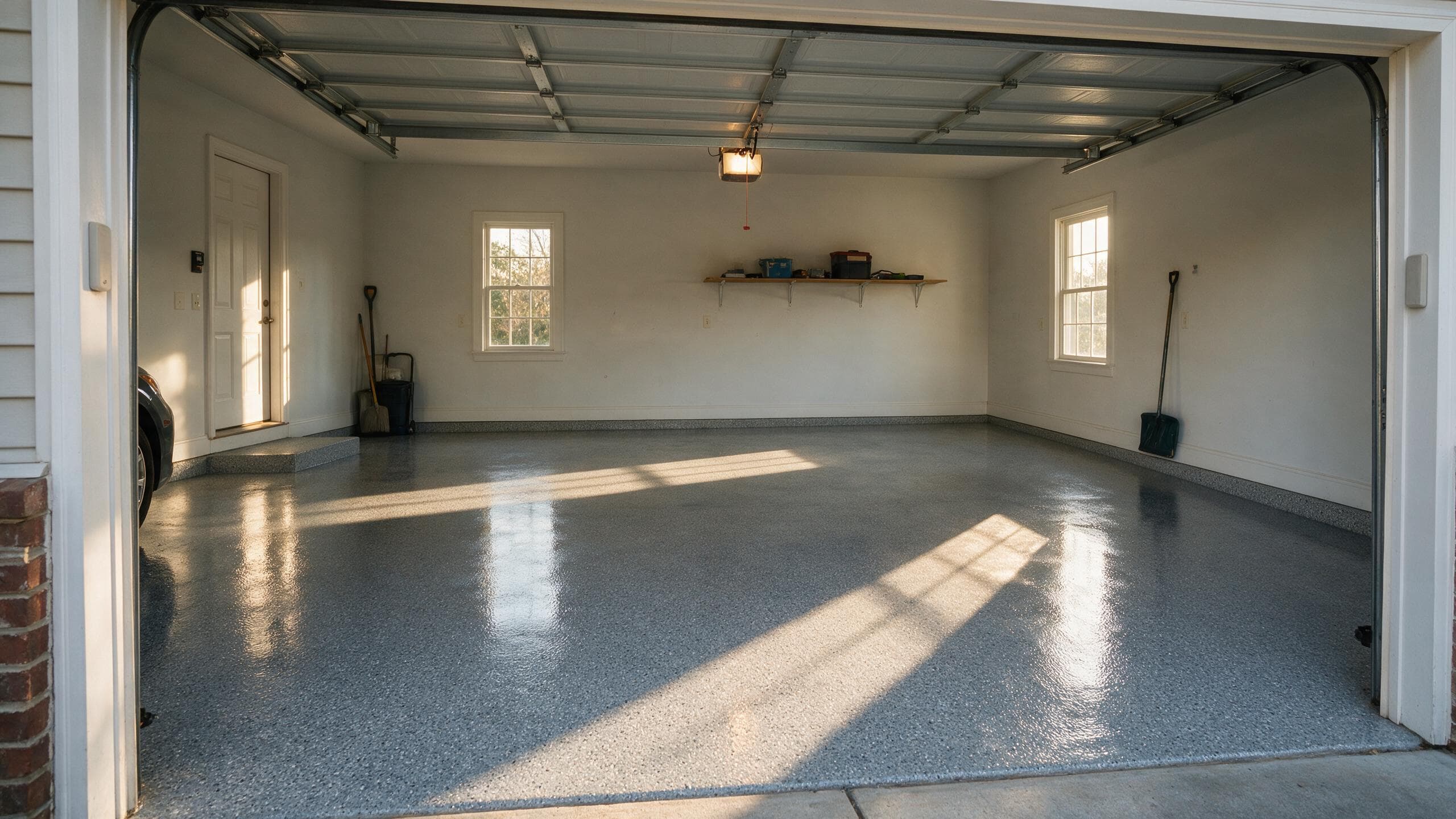
For most Charlotte garages, yes. Polyaspartic costs roughly $900 to $1,800 more than flake epoxy on a standard 450 sqft two-car garage. That buys five to eight extra years of service life, a one-day install instead of a lost week, and a topcoat that will not yellow at the door line or lift when hot tyres park on it. Per year of use, it is normally the cheaper floor. The exceptions are real though, and they are listed further down.
What the Gap Actually Is
| System | Rate | 450 sqft Garage | Service Life | Downtime |
|---|---|---|---|---|
| Solid color epoxy | $4–7/sqft | $1,800–3,150 | 8–12 yrs | 3–5 days |
| Flake epoxy + urethane top | $5–8/sqft | $2,250–3,600 | 10–15 yrs | 3–5 days |
| Flake epoxy + polyaspartic top | $6–10/sqft | $2,700–4,500 | 12–18 yrs | 1–2 days |
| Full polyaspartic system | $7–12/sqft | $3,150–5,400 | 15–20 yrs | 1 day |
Based on a 450 sqft two-car garage, the Charlotte metro average. All projects carry a $1,400 minimum, which compresses the gap noticeably on single-bay garages.
Run the middle of each range across the service life and the picture inverts. A flake epoxy floor at $2,900 over twelve and a half years is about $232 a year. A polyaspartic floor at $4,275 over seventeen and a half years is about $244 a year. Those are close enough to call even, which means the annual cost is roughly a wash and everything else becomes the tiebreaker: the lost week, the yellowing, the hot tyre risk. That is where polyaspartic wins.
One number that surprises people: the gap shrinks as the garage gets bigger, not larger. Grinding and mobilisation are a fixed share of a small job, so on a single-bay garage the two quotes can land within a few hundred dollars of each other once the project minimum is applied. On a three-car garage the material difference dominates and the spread widens.
What the Extra Money Buys
Five to eight more years of service life
A flake epoxy floor in a Charlotte garage gives 10 to 15 years. A full polyaspartic system gives 15 to 20. Take the middle of each range and the polyaspartic floor costs roughly $230 a year against $250 for the epoxy, on a two-car garage. The upfront number is higher and the annual number is lower, which is the whole argument in one line.
Your garage back in one day
Each polyaspartic coat cures in 60 to 90 minutes, so the entire installation finishes in a single working day. Epoxy needs overnight between coats and 3 to 5 days before a vehicle returns. For a household with one garage and two cars, that week of displacement has a real cost even though it never appears on the quote.
No yellowing at the door line
Epoxy is not UV stable. Sunlight coming through an open garage door ambers the resin, and it shows as a discoloured band across the front of the floor within a few years. Polyaspartic holds its colour. On south and west facing Charlotte garages this is usually the deciding factor rather than a bonus.
Real resistance to hot tyre pickup
Tyres coming off Charlotte asphalt in July arrive far above ambient temperature. On a thin or soft coating the rubber bonds to the surface and tears it away when the car moves. Polyaspartic stays harder at elevated temperature, which is why we specify it as the topcoat on close to every garage we quote here.
It handles cold better during install
Polyaspartic cures reliably down to around 0°F, where epoxy becomes sluggish and unpredictable below roughly 50°F. In practice this means a January install in an unheated Charlotte garage is straightforward with polyaspartic and a scheduling problem with epoxy.
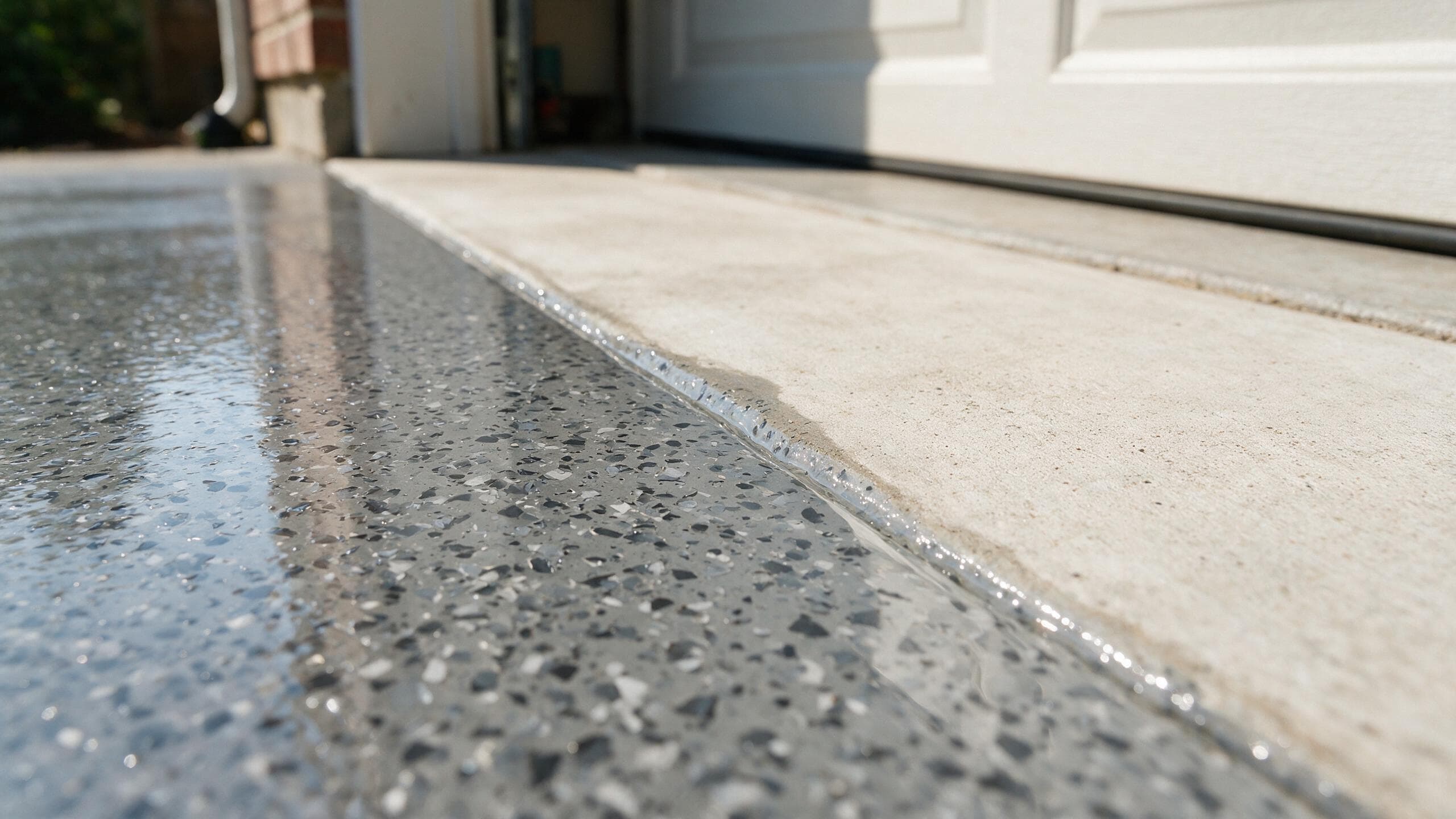
Topcoat going down the same afternoon the slab was ground. The short cure window is why the whole job closes in a day
When We Tell People Not to Pay for It
We quote both systems because both are the right answer some of the time. These are the three cases where we actively steer people toward the cheaper floor.
Interior rooms with no sun and no vehicles
A finished basement, a laundry room, or a hobby space has none of the stresses polyaspartic is built to resist. Flake epoxy at $5–8 per square foot does the same job there for less money.
A slab you are replacing inside five years
If the garage is coming out during a planned rebuild or addition, the extra lifespan never gets collected. Put the cheaper system down and spend the difference on the rebuild.
A slab with unresolved moisture or cracking
Vapour driving up through Charlotte clay pushes any coating off from beneath, and polyaspartic is no exception. That budget belongs in crack repair and a moisture-mitigating primer at $0.50–0.75 per square foot before anything else. A premium topcoat over an untested slab is money set on fire.
The third one deserves emphasis, because it is the most expensive mistake in this category. Preparation and slab condition decide whether a floor lasts, not the resin on top. A polyaspartic system over an acid-etched or untested slab will fail sooner than a properly ground epoxy floor, and it will cost more doing it. If a quote is silent on diamond grinding and slab moisture testing, the coating grade on the line above is not the number that matters.
We quote both systems on the same visit, with the slab moisture reading in hand, so you can see the real gap on your garage rather than a national average. Free across the Charlotte metro.
Get Free EstimateFrequently Asked Questions
Related Guides
Share this guide: