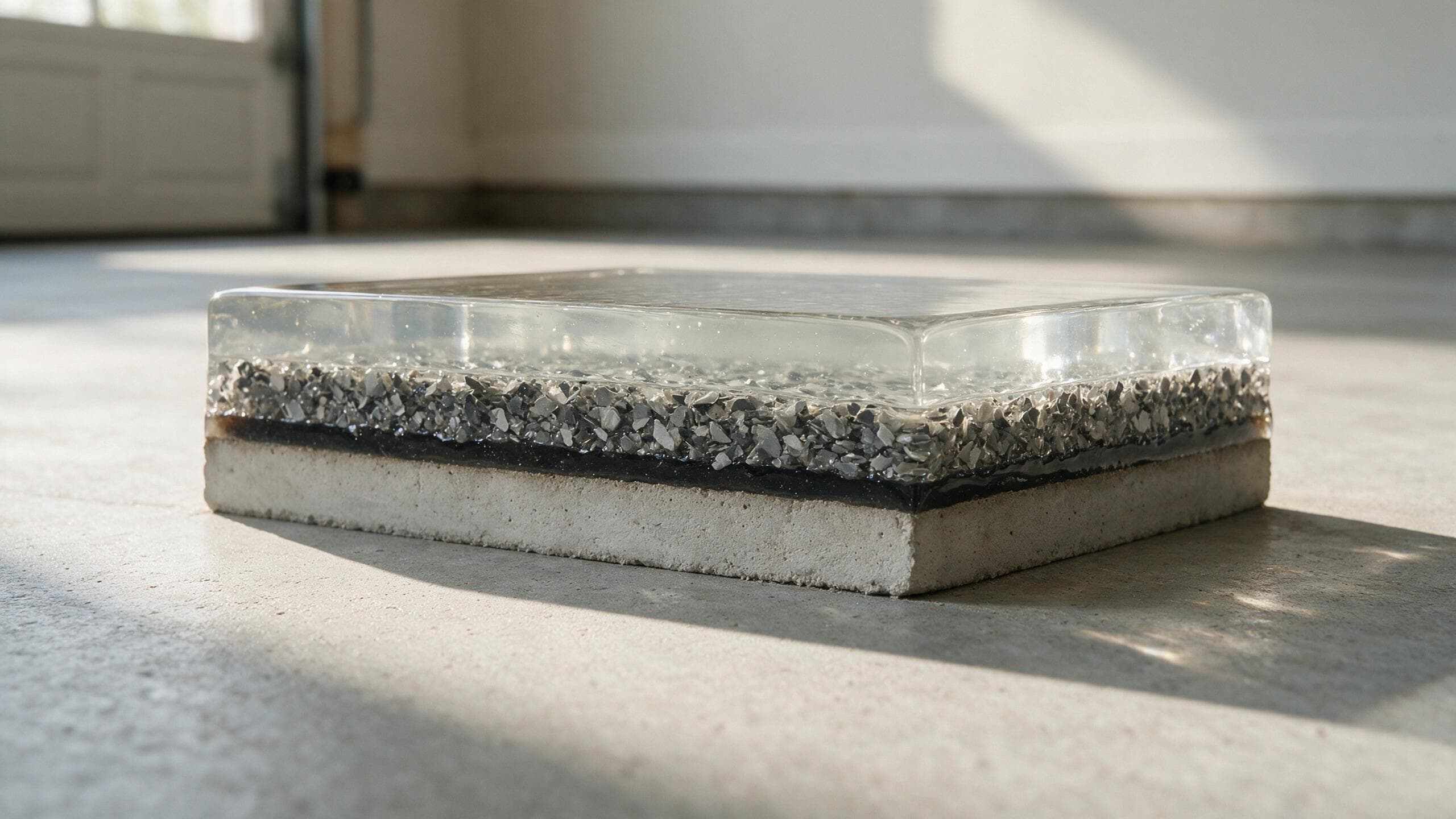
These are not two competing products. Polyaspartic is a type of polyurea. Polyurea is the chemical family; polyaspartic is the slower-reacting member of it that can actually be applied by hand. In a well built Charlotte garage floor you will usually find both: a fast polyurea base coat down on the ground concrete, and a UV-stable polyaspartic topcoat over the flake.
Why the Names Confuse Everyone
Polyurea is formed by reacting an isocyanate with an amine. That reaction is violently fast: a standard polyurea can go from liquid to solid in five to thirty seconds, which is why industrial polyurea is sprayed from a heated plural-component rig that mixes the two parts at the nozzle. You cannot pour it out and spread it. It would set before the squeegee reached the far wall.
Polyaspartic changes one ingredient. It swaps the standard amine for a polyaspartic ester, a modified amine that reacts far more slowly with the same isocyanate. That single substitution stretches the working window from seconds to 60 or 90 minutes, and everything useful about polyaspartic as a floor coating follows from it. It can be mixed in a bucket, poured out, spread by hand, and back-rolled to an even film.
So when a contractor says polyurea and another says polyaspartic, they may be describing the same category of system. Neither is being dishonest. The word itself simply does not tell you enough, which is why the comparison that matters is layer by layer rather than name against name.
Side by Side
| Property | Standard Polyurea | Polyaspartic |
|---|---|---|
| Chemical family | Polyurea (parent family) | Polyurea subtype |
| Reaction speed | 5–30 seconds | 60–90 minutes |
| Application method | Plural-component spray rig | Squeegee and roller by hand |
| UV stability | Usually not stable, ambers | Stable, holds colour |
| Typical layer | Base coat | Topcoat |
| Flexibility | High, bridges hairline cracks | Moderate to high |
| Cold tolerance | Down to around 0°F | Down to around 0°F |
Formulations vary between manufacturers, and some polyurea products are UV stabilised. Treat this as the general case rather than a universal rule.
Which Material Belongs in Which Layer
Polyurea base coat: penetration and speed
A fast-setting polyurea soaks into freshly ground concrete and locks in before it can pool or run. Because it sets in minutes rather than hours, flake can be broadcast into it during the same visit rather than the next morning. Its appearance does not matter, because nothing about it will be visible once the flake and topcoat go down.
Polyaspartic topcoat: the surface you actually live with
The topcoat is what takes tyre contact, sunlight, dropped tools, and cleaning products. Polyaspartic is UV stable, so a grey floor stays grey rather than drifting amber at the door line, and it stays hard at the temperatures Charlotte tyres arrive at in July. The longer working window also lets it be laid out evenly by hand, which is what a smooth finish requires.
Why not polyurea on top
Two reasons. It sets far too quickly to spread evenly with a squeegee, so hand application leaves ridges and lap marks. And most polyurea formulations are not UV stable, which puts you back in the position epoxy is in: a discoloured band across the front of the garage within a few years.
Why not polyaspartic underneath
You can, and plenty of full polyaspartic systems do exactly that. The tradeoff is time and cost. A polyaspartic base needs a longer wait before flake broadcast than a polyurea base does, and the material costs more for a layer nobody will ever see.
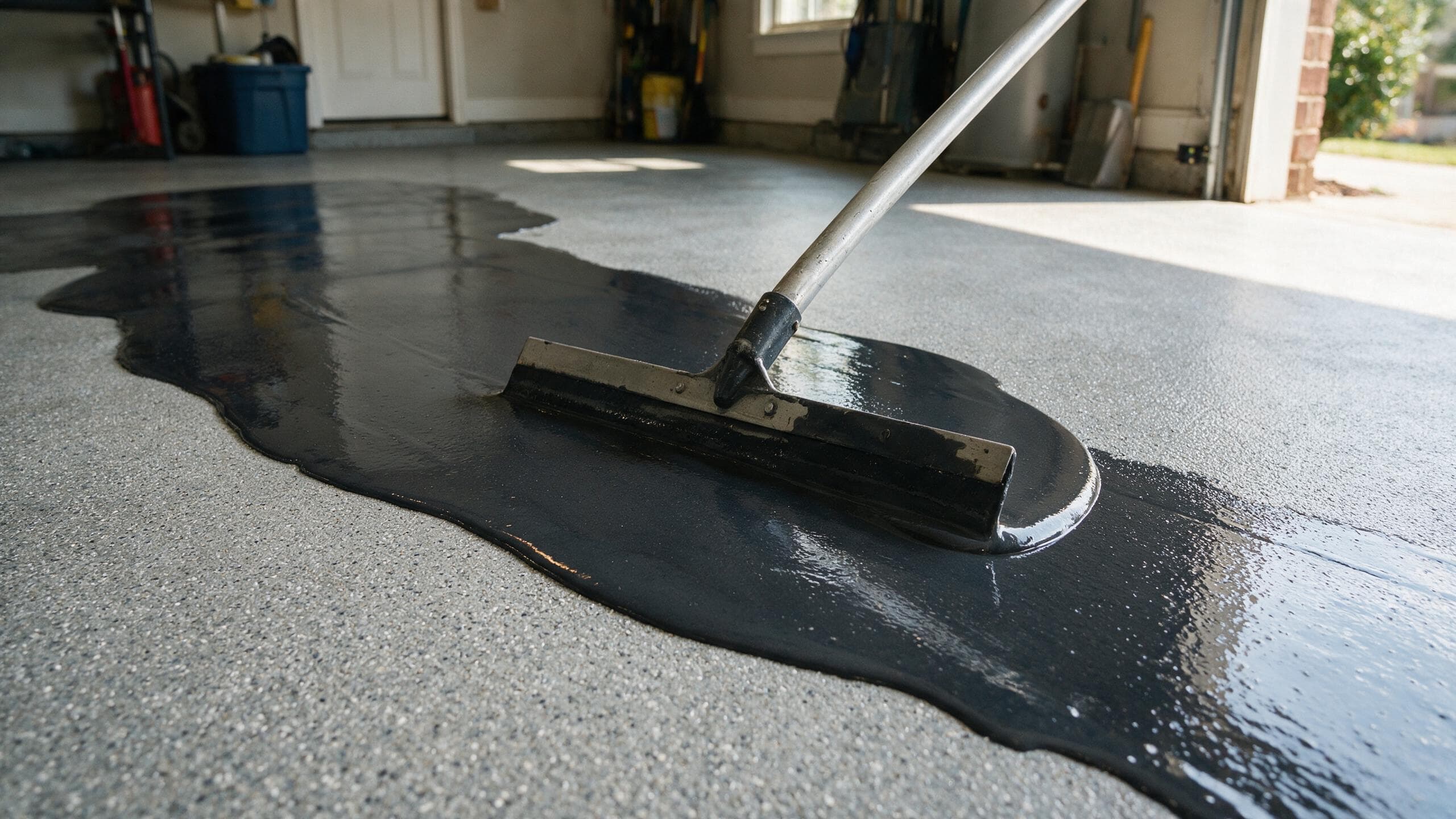
The topcoat going down over flake. This is the layer where UV stability and working window both matter
What to Ask Instead
Because the terminology overlaps, comparing two quotes on the product name gets you nowhere. Four questions separate the systems properly, and any competent installer will answer all of them without hesitating.
What is in each layer? Base coat, broadcast, topcoat, named individually. What is the total film thickness in mils? A professional garage system lands between 25 and 40; a consumer kit is 2 to 3. Is the topcoat UV stable? If it is not, expect ambering at the door line regardless of what family it belongs to. How is the slab prepared? Diamond grinding rather than acid etching, with slab moisture measured beforehand.
That last one outranks every chemistry question on this page. Preparation decides whether a floor lasts. We have ground off premium polyurea systems that failed in two years because they went over an etched slab, and we regularly see straightforward flake epoxy at twelve years and holding because the prep was right.
Comparing quotes that use these words differently? Send them over. We will tell you what each one is actually specifying, including where ours is the more expensive option. Free across the Charlotte metro.
Get Free EstimateFrequently Asked Questions
Related Guides
Share this guide: