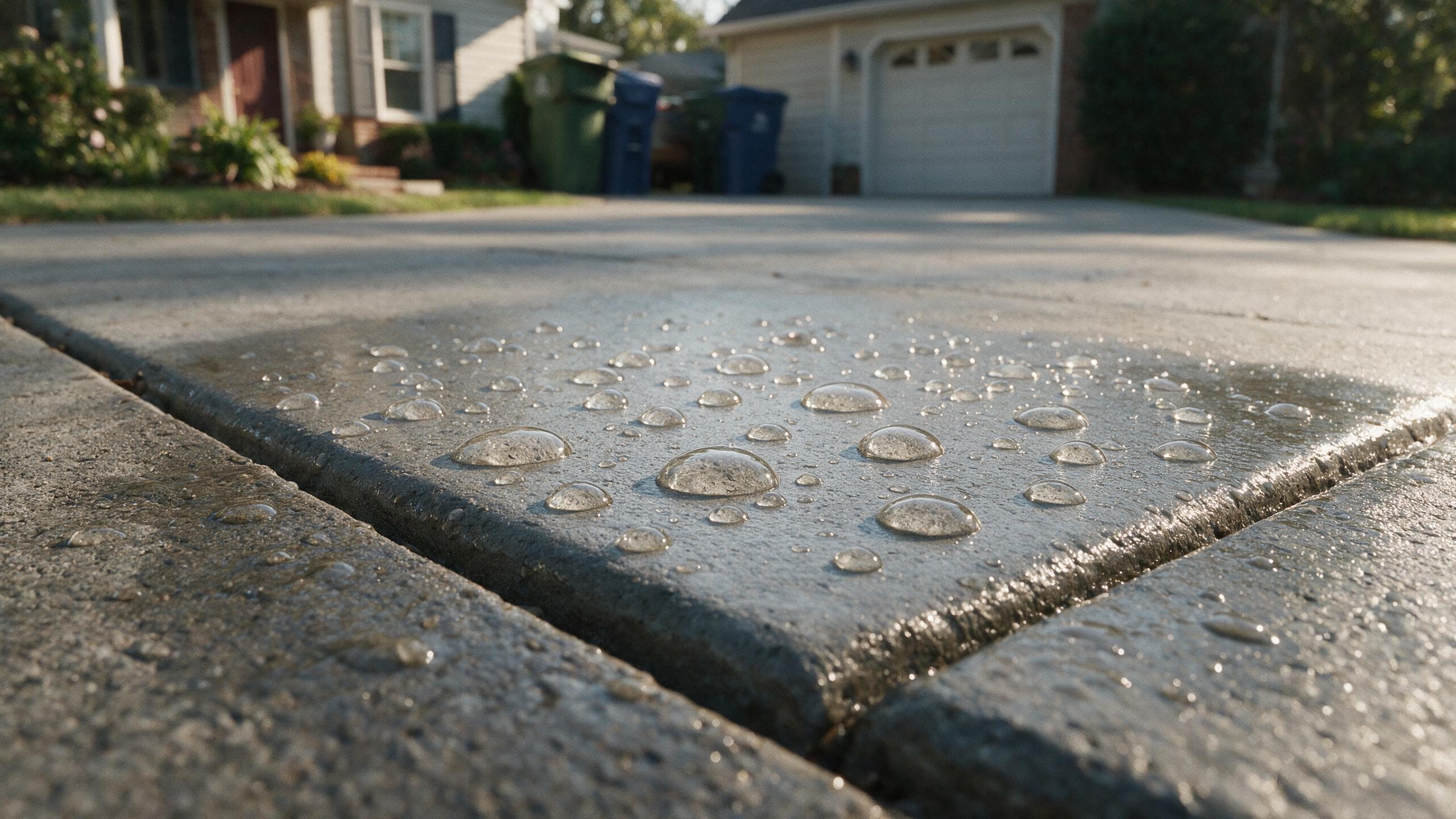
A sealer goes into the concrete and leaves no film. The floor still looks like concrete. A coating goes on top as a 15 to 40 mil layer and becomes the new surface. Sealing costs $1.50–3 per square foot and lasts 3 to 5 years on traffic. Coating costs $4–12 and lasts 10 to 20. Neither is better. They solve different problems, and the expensive mistake is coating over a sealed slab.
Side by Side
| Factor | Penetrating Sealer | Coating |
|---|---|---|
| Where it sits | Inside the concrete | On top, 15–40 mils |
| Cost per sqft | $1.50–3 | $4–12 by system |
| Lifespan | 3–5 yrs trafficked | 10–20 yrs |
| Appearance change | None to slight darkening | Total, colour and gloss |
| Chemical resistance | Limited | Good to excellent |
| Can it peel | No, nothing to release | Yes, if prep was wrong |
| Stops dusting | Yes | Yes |
| Hides slab defects | No | Yes |
| Exterior in NC | Well suited | Only where covered |
Sealer lifespan assumes a trafficked surface. On a low-traffic interior slab the same product can run considerably longer.
Into the Slab, or On Top of It
Concrete is porous. A penetrating sealer, usually a silicate or siliconate densifier, is a thin liquid that soaks into those pores and reacts with free lime inside the slab to form a hardened, tightened structure below the surface. Nothing is left sitting on top. Run your hand across a sealed floor and it feels like concrete, because it is concrete. What has changed is that it now sheds water rather than drinking it, and it has stopped giving up dust.
A coating does the opposite. It bonds to a mechanically prepared surface and builds a film of 15 to 40 mils, roughly the thickness of a few sheets of paper stacked. That film is now the wear surface, and everything that happens to the floor happens to the coating rather than to the concrete. It can be pigmented, flaked, textured, or run up a wall as a cove.
Everything else in this comparison follows from that one difference. A sealer cannot peel because there is nothing to release. A sealer also cannot hide a patch repair, cannot form a cove, and cannot give up 30 mils of thickness to abrasion, because it has no thickness at all.
Which One for Which Job
Seal a driveway or exposed exterior slab
Direct sun, standing water, and freeze-thaw cycling are hard on any film. A penetrating sealer protects against salt and moisture ingress without giving UV anything to attack or water anything to get underneath. Nothing can peel because nothing is sitting on the surface.
Seal a slab whose only problem is dust
If a basement or shop floor is structurally fine and you just want it to stop shedding grey powder onto everything, a densifier does that at a third of the cost of coating. You keep a concrete floor, which some people want anyway.
Coat a garage that takes vehicle traffic
Hot tyres, dropped tools, oil drips, and road salt all argue for a real wear layer. A sealed garage slab is still a bare concrete garage slab: it will stain, and it offers no abrasion build to give up. This is the clearest case for coating in a Charlotte home.
Coat anything that needs to be cleanable
Kitchens, food production, veterinary space, and any room with a sanitation standard need a non-porous surface, usually with a coved base detail up the wall. Sealed concrete stays porous at the surface and cannot form a cove. Coating is the only option that meets the requirement.
Coat when appearance is the point
A sealer will not hide patch repairs, colour variation, or the map of every change the slab has been through. If the floor needs to look designed rather than functional, that is a coating decision. Flake, metallic, and solid colour systems all exist for this reason.
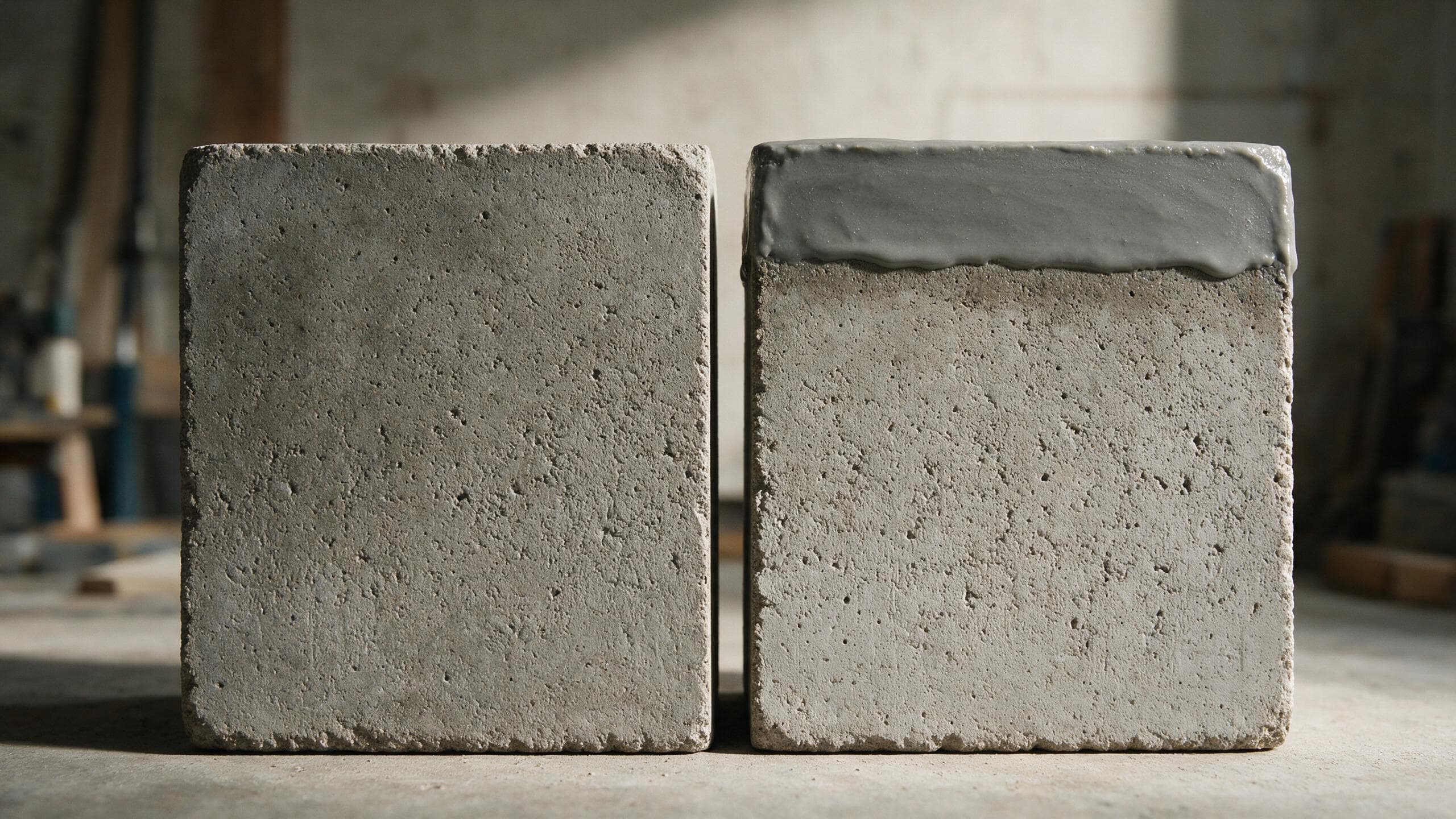
Cut in half, the difference is obvious: the sealer has no measurable thickness, the coating is a distinct band on top
The Expensive Mistake: Coating Over a Sealed Slab
This is the one genuine trap in the topic, and we strip floors because of it several times a year. A coating bonds by keying into the open pore structure of prepared concrete. A sealer works by filling that exact pore structure. Put a coating over a sealed slab and it has nothing to grip, so it sits there looking correct for a year or two and then releases in sheets.
The tell on a failed floor is the underside of a lifted piece. If it comes away clean and glossy with no concrete attached, the bond never formed. Where a properly ground floor fails, pieces come up with concrete stuck to them, because the coating held and the substrate gave way instead.
Removal means full mechanical grinding to take the sealer back off, which is a real cost on top of a cost already paid. If a slab has ever been sealed, say so at the estimate. It changes the preparation scope and it is far cheaper to grind deliberately than to grind twice.
Not sure which your slab needs? We will tell you when a sealer is enough, including when that means a smaller job than you came to us for. Free estimates across the Charlotte metro.
Get Free EstimateFrequently Asked Questions
Related Guides
Share this guide: