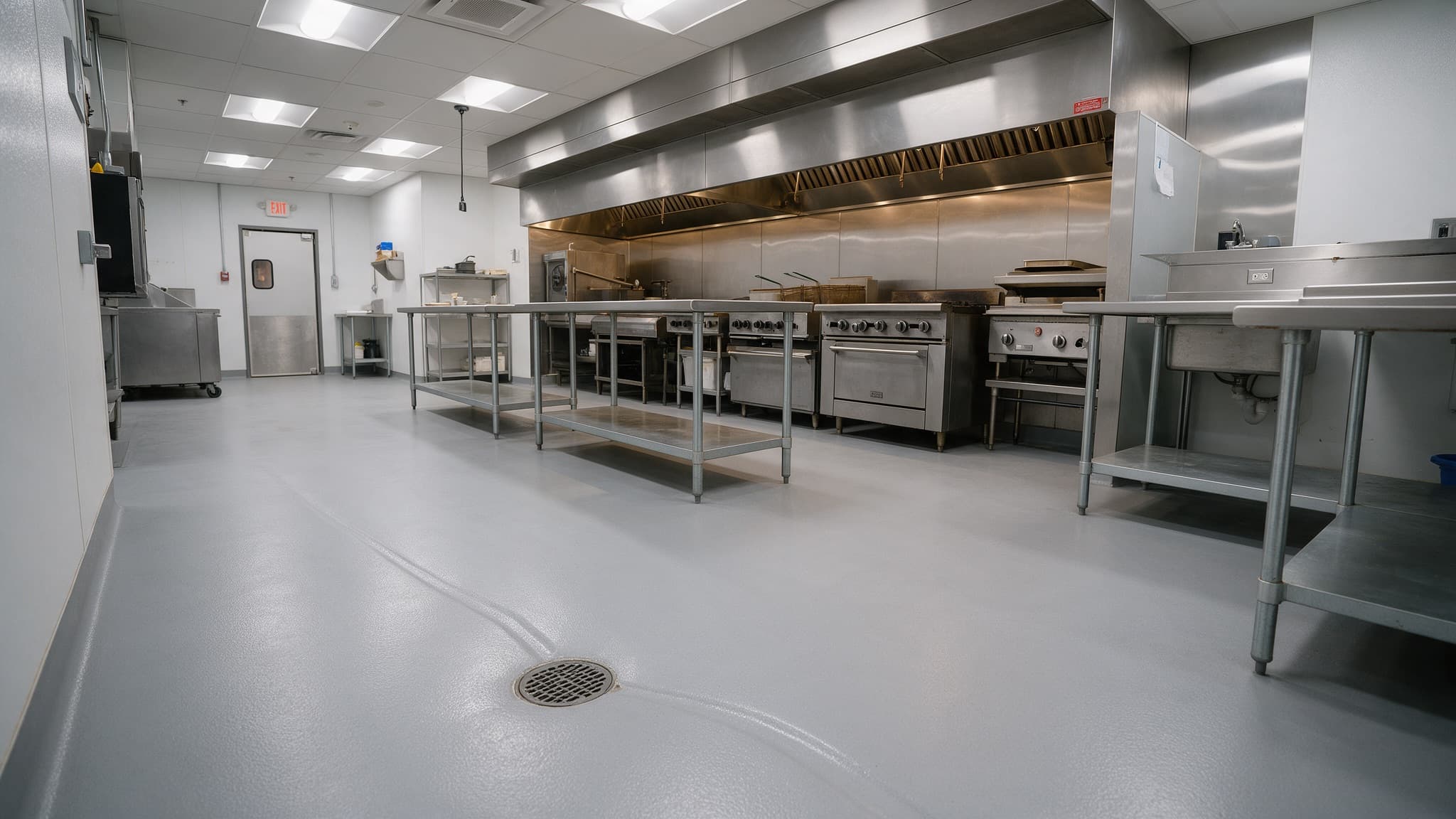
For a cook line or dish pit, the answer is usually urethane cement rather than standard epoxy, because thermal shock from boiling water debonds rigid coatings. Whichever resin you use, the code is specific: floors smooth, durable, easily cleanable and nonabsorbent where moisture is present, and floor to wall junctures coved and closed to no larger than 1 mm. Where water flush cleaning is used, add drains, grading to drain, and a sealed cove.
What the Code Actually Says
| Requirement | Section | What It Means on Site |
|---|---|---|
| Smooth, durable, easily cleanable | 6-101.11(A)(1) | No porous or textured substrate, no open seams |
| Nonabsorbent where moisture is present | 6-101.11(A)(3) | Prep, warewashing, walk-ins, spray-cleaned areas |
| Designed and installed smooth and cleanable | 6-201.11 | Applies to the installation, not just the product |
| Antislip permitted for safety | 6-201.11 | Aggregate in the topcoat is explicitly allowed |
| Junctures coved, closed to 1 mm | 6-201.13(A) | No open gap at the floor and wall line |
| Water flush: drains, graded, coved and sealed | 6-201.13(B) | Sloped to drain plus a sealed cove |
Section numbers are from the Food Code adopted by North Carolina through 15A NCAC 18A .2600. Your county may apply additional plan review requirements.
Why Standard Epoxy Often Fails in a Kitchen
A kitchen floor is not abused the way a warehouse floor is. It is abused thermally. A pot of boiling water emptied into a floor sink, a dish machine venting steam, a fryer cleaned down at the end of service: each of those puts a large, sudden temperature change into a small area of slab, several times a day, every day.
Concrete and a rigid resin expand at different rates. Cycle them hard enough and often enough, and the stress goes into the bond line between them. That is why a kitchen floor frequently fails as debonding at the cook line and dish pit while the dry storage area, coated the same day with the same product, remains sound years later.
Urethane cement is formulated around this problem. Its thermal expansion behaviour is far closer to concrete, so the cycling does not translate into the same shear at the bond. It is also typically laid thicker than a standard epoxy build. It costs more than a standard commercial resin system, which runs $5–9 per square foot installed, and it is quoted per kitchen because thickness and detailing vary with the equipment layout.
Five Things to Get Right in the Spec
Urethane cement at the cook line, not epoxy
Thermal shock is the defining stress in a commercial kitchen. Boiling water hitting a slab that sits at room temperature, repeated several times a shift, moves a rigid coating against the concrete until the bond fails. Urethane cement tolerates that cycling and is what we specify at cook lines, dish pits and anywhere steam or hot water hits the floor routinely.
The cove is a code requirement, not a finish detail
Section 6-201.13 is explicit: junctures coved and closed to no larger than 1 mm where cleaning is not water flush, and coved and sealed where it is. A coved base carries the resin up the wall in one continuous curve so there is no joint for grease and water to enter. Budget $8–12 per linear foot and treat it as part of the floor rather than as an add-on.
Slope and drains come before resin
Where water flush cleaning is used, 6-201.13(B) requires the floor to be provided with drains and graded to drain. A resin floor follows the slab it is laid on, so if the existing slab does not fall to the drains, that has to be corrected in the substrate first. Discovering this after the coating is down means doing the floor twice.
Specify the antislip grade by zone
The code permits antislip applications for safety reasons, and a kitchen genuinely needs them where water and oil reach the floor. Use a coarser aggregate at the dish pit and cook line, and a finer grade in dry storage and prep where cleanability matters more. A single aggressive profile across the whole kitchen traps grease and makes the cleaning schedule harder to keep.
Confirm the edition with your county inspector
North Carolina adopts the FDA Food Code by reference through 15A NCAC 18A .2600, and the adopted edition has been updated over time. County health departments also apply their own plan review. Before finalising a spec, confirm the current edition and any local requirements with the inspector who will actually sign off the kitchen. Nobody wants to discover a cove radius disagreement at final inspection.
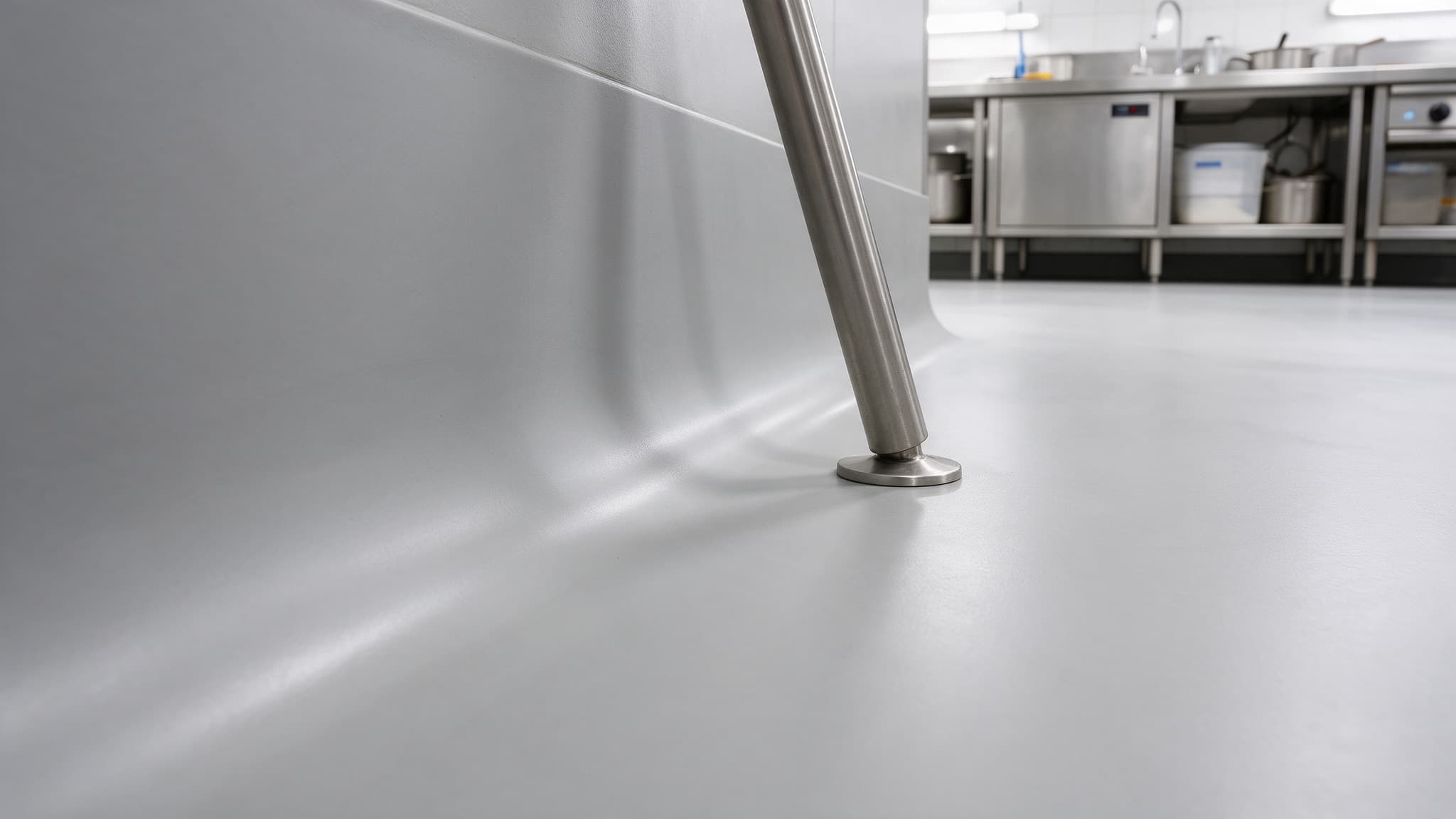
This is what 6-201.13 is asking for: one continuous curve from floor to wall, no gap, nothing for grease or water to get into
Plan Review Before Product Choice
If you are fitting out a new kitchen or doing a substantial renovation, the floor spec goes through plan review with the county health department alongside everything else. That is an opportunity rather than an obstacle: ask the inspector what they want to see on the drawing for the cove detail and the drainage before anyone orders material.
For an existing kitchen being refloored, the two questions that decide scope are whether the slab already falls to the drains and whether the existing cove, if there is one, can be kept. Both are answered on site in an hour, and both can change the number materially, which is why we will not quote a commercial kitchen from a floor area alone.
We survey the slope to your drains and the condition of any existing cove before quoting, so the number you get is the number that passes inspection. Free across the Charlotte metro, including phased work for kitchens that have to keep trading.
Get Free EstimateFrequently Asked Questions
Related Guides
Share this guide: