
For a dry distribution warehouse, polished concrete is usually the better long-term floor. It cannot delaminate, it has no recoat cycle, and it can be installed in phases with same-day handback. For anything involving chemicals, wash-down, thermal shock, or sanitation requirements, a resin system is the only real option, because polished concrete offers no chemical barrier whatsoever. Slab condition, not preference, decides most of the remainder.
Side by Side
| Factor | Polished Concrete | Industrial Resin |
|---|---|---|
| Cost per sqft | $4–10 | $5–9 standard build |
| Forklift abrasion | Excellent, burnishes with use | Good, wears at traffic lanes |
| Delamination risk | None, no film to release | Real, prep dependent |
| Chemical resistance | Poor, no barrier | Excellent, spec dependent |
| Downtime | Phased, same-day handback | 24 hrs to 5 days per area |
| Joint spalling | Needs semi-rigid filler | Needs semi-rigid filler |
| Light reflectance | High, cuts lighting load | High if gloss specified |
| Recoat cycle | None, re-polish at 10+ yrs | Topcoat every 5–8 yrs |
Rates are Charlotte metro installed pricing on sound slabs. Crack and joint repair is quoted separately on both systems because it varies more than the floor finish does.
Forklift Traffic Is Not the Deciding Factor
Most people arrive at this comparison assuming abrasion resistance settles it. It generally does not, because both systems handle warehouse traffic well when specified properly. Densified polished concrete draws its hardness from the slab itself, so there is no film to wear through and traffic actually burnishes the surface over time. A correctly built industrial resin floor at 25 to 40 mils takes the same traffic and shows wear at the lanes first, which is expected and addressed with a topcoat refresh at five to eight years.
The genuine wear problem in a warehouse is not the field of the slab at all. It is the control joints. Hard polyurethane forklift wheels crossing an unfilled or poorly filled joint hammer the unsupported concrete edges thousands of times a day, and those edges break down into spalling that widens the joint and worsens the impact. Once that cycle starts it accelerates.
Semi-rigid joint filler solves it on both floors by supporting the joint edges while still allowing the slab to move. It is the single most consequential line item on a warehouse floor quote and the one most often dropped when a price needs to come down. If you compare two quotes and one is cheaper, check the joint treatment before concluding anything about the floor system.
Five Questions That Actually Decide It
Is anything corrosive hitting the floor
This is the first question and it settles most jobs on its own. Polished concrete is densified concrete, which means it has no chemical barrier. Battery acid at a charging station, hydraulic fluid, brine, or food-processing waste will etch and stain it permanently. If any of those are present, specify resin and stop comparing.
How much downtime can the operation absorb
A polish is a dry mechanical process with no cure window, so a crew can rope off two aisles, finish them, and hand them back the same shift. A resin floor takes the area out of service for a full cure. In a running Charlotte distribution centre we have seen the downtime difference dwarf the material cost difference on the same slab.
What condition is the slab actually in
Polishing exposes what is already there. A slab with random cracking, patch repairs, or uneven aggregate will show all of it once ground, and no amount of grit progression hides that. A resin build covers it. On a rough or heavily repaired warehouse slab, appearance alone can push the decision toward coating.
Are the control joints filled
This decides both floors and gets skipped on both. Hard forklift wheels crossing an unfilled joint hammer the unsupported edges until they spall, and once a joint starts breaking down the repair is disruptive regardless of what is on the surface. Semi-rigid joint filler is not an upgrade line, it is a requirement in any building with hard-wheeled traffic.
What is the racking layout doing to the schedule
Neither floor can be installed under loaded racking. The practical constraint in most Charlotte warehouse projects is not the floor system, it is how much racking can be emptied and moved at once. Phasing around live racking adds mobilisations to both options and adds them faster to the resin option, because each phase carries its own cure window.
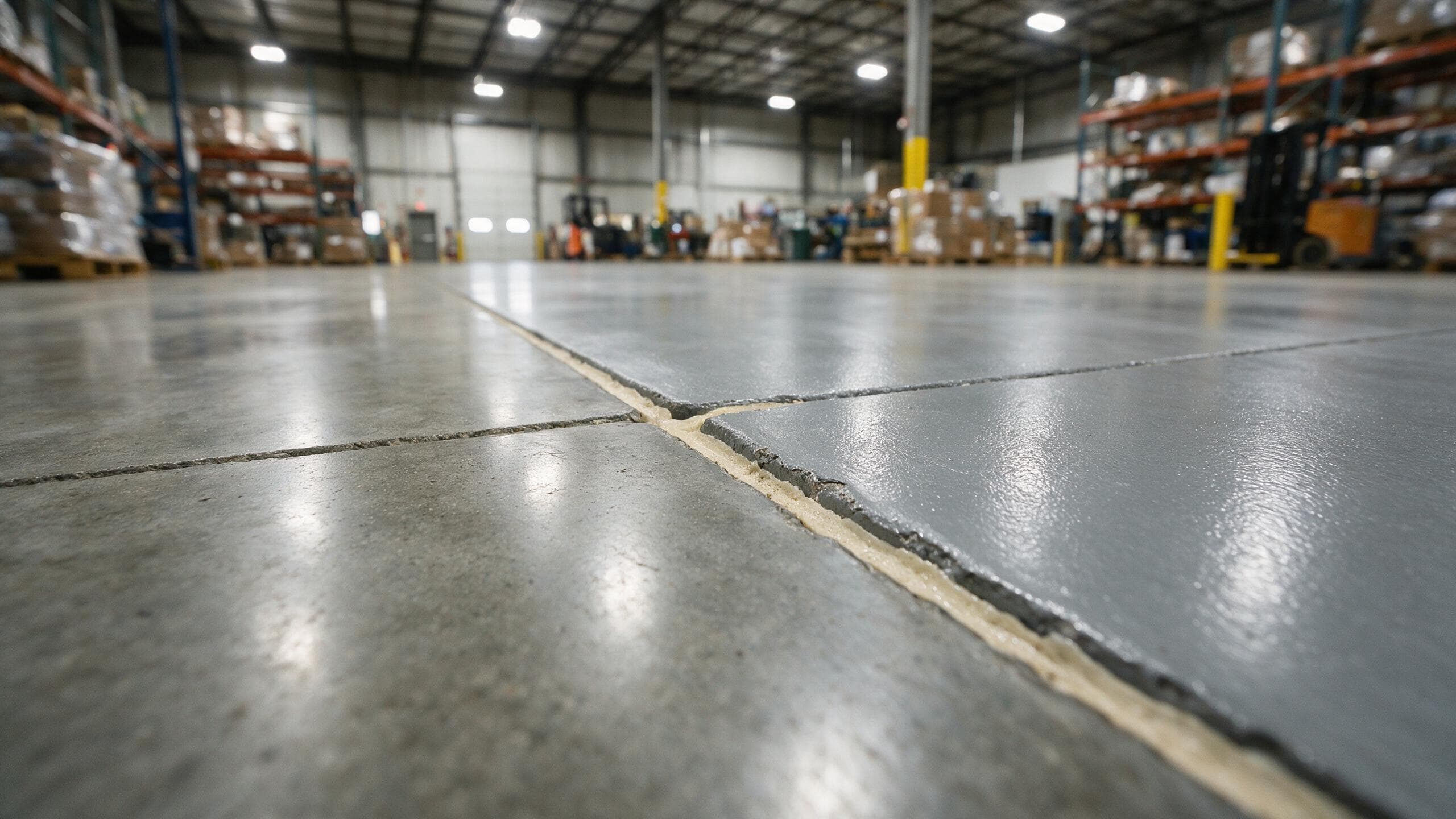
The joint is where warehouse floors fail, on either system. Semi-rigid filler supporting both edges is what prevents it
Where Resin Is the Only Answer
Polished concrete is concrete. That is its strength and its limit. Densifier reacts with free lime in the slab to harden and tighten the surface, which improves abrasion resistance and dramatically reduces dusting, but it does not create a barrier. Anything that attacks concrete still attacks a polished floor.
In practice that rules polish out of battery charging areas, where sulphuric acid etches the surface permanently. It rules it out of food and beverage production, where sanitation standards require a cleanable non-porous surface and often a coved, sloped-to-drain detail that only a resin system can form. It rules it out of freezer and thermal-shock environments, where urethane cement is specified instead. And it rules it out anywhere hydraulic fluid or cutting oils are a routine presence rather than an occasional spill.
Mixed-use buildings are the common real case in Charlotte. A distribution floor with a small maintenance bay and a charging area is best served by polishing the open floor and coating the two zones that need chemical resistance, with a clean transition detail between them. That is usually cheaper than coating the entire building and considerably more durable than polishing all of it and hoping.
We assess warehouse slabs with a test grind before quoting, so the aggregate exposure and repair scope are known rather than assumed. Free across the Charlotte metro, including phased scheduling around live racking.
Get Free EstimateFrequently Asked Questions
Related Guides
Share this guide: