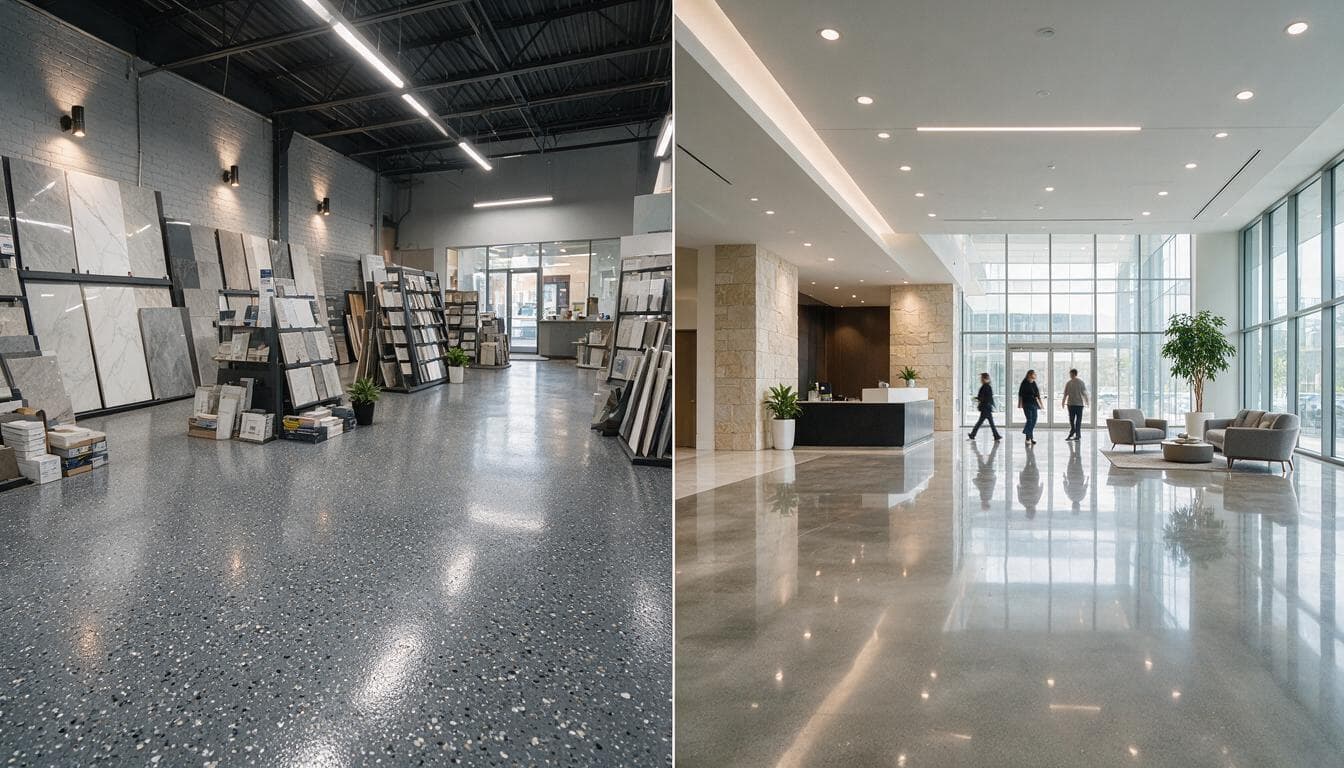
Epoxy coatings and polished concrete are often quoted as alternatives to each other — and both get recommended for garages, retail floors, warehouses, and commercial offices. They're not the same thing, and choosing the wrong one is an expensive mistake. Epoxy is a coating applied on top of concrete. Polished concrete is the concrete itself, mechanically refined. That distinction drives every difference in cost, durability, look, and maintenance. This guide breaks them down side by side — with Charlotte-specific costs and honest recommendations by use case.
Quick Verdict — Side-by-Side Comparison
Neither system is universally better. The right call depends on the space, budget, and how the floor will be used. Here's the full picture before the detailed breakdown.
| Factor | Epoxy Coating | Polished Concrete |
|---|---|---|
| What it is | Coating applied on top of slab | The concrete slab itself, refined |
| Cost | $3–12/sqft (system-dependent) | $6–20/sqft (gloss-dependent) |
| Durability | 10–15 years before topcoat refresh | 20–30+ years — permanent |
| Maintenance | Mop + occasional topcoat refresh | Mop + re-seal every 2–5 years |
| Can peel/chip | Yes — if prep is inadequate | No — it's the concrete |
| Decorative range | Wide — chips, metallic, colors | Limited — aggregate and gloss |
| Slip resistance | Moderate (additive available) | Moderate (texture-dependent) |
| Best residential | Garages, basements, workshops | Feature rooms, basements |
| Best commercial | Warehouses, restaurants, kennels | Retail, offices, lobbies |
| DIY available | Yes (kit — not recommended) | No |
The honest answer for most Charlotte garages: epoxy wins on value. The honest answer for most Charlotte commercial lobbies, retail floors, and offices: polished concrete wins on longevity. For everything in between — it depends on budget and how permanent you want the decision to be.
Epoxy Coatings — Strengths and Weaknesses
Epoxy flooring is a two-part chemical system — a resin and a hardener that bond when mixed and applied to diamond-ground concrete. A proper install includes a moisture-tolerant primer, a high-build base coat, and a UV-stable polyaspartic or polyurethane topcoat. The full system is typically 15–20 mils thick — enough to hide surface imperfections, seal the slab, and withstand daily residential or commercial use for a decade or more.
In Charlotte, where clay-heavy soil and seasonal humidity create moisture conditions that can delaminate a poorly prepped coating within 18 months, the quality of the install is everything. Commercial-grade 100% solids epoxy — not the consumer-grade water-based products in home improvement stores — is what separates a 15-year floor from a 2-year failure.
Strengths
- ✓Widest decorative range — chips, metallic, solid color, quartz broadcast
- ✓Lower entry cost — standard flake system starts at $4–7/sqft installed
- ✓Can be applied to almost any concrete condition after proper prep
- ✓Fast turnaround — most Charlotte residential garages complete in 1–2 days
- ✓Highly customizable — dozens of colors and textures
- ✓Anti-slip additives available for wet areas
Weaknesses
- ✗It's a coating — it can peel if prep is inadequate or moisture is not mitigated
- ✗UV-reactive standard epoxy yellows outdoors without aliphatic topcoat
- ✗Topcoat needs refreshing every 7–10 years under heavy commercial traffic
- ✗Quality is entirely prep-dependent — a shortcut on grinding or moisture testing = failure within 2 years
Charlotte's clay-heavy soil and seasonal moisture means prep quality matters more here than in drier climates. An improperly prepped slab will fail regardless of which epoxy system is applied.
See our garage floor coating services →
Polished Concrete — Strengths and Weaknesses
Polished concrete is not a coating system. It's the slab itself, refined through a series of diamond grinding and polishing passes at progressively finer grits — 400, 800, 1500, 3000 — with a concrete densifier applied between passes to harden the surface and a penetrating stain guard applied at the end. The finished floor you walk on IS the concrete slab. There is no coating above it to peel, chip, or replace.
That distinction is both polished concrete's greatest strength and its main limitation. Because you're refining the concrete itself, the result depends entirely on what the concrete can give you. A slab with unusual aggregate, significant surface damage, or a history of previous coatings may not achieve the mirror gloss seen in design showrooms. We assess every Charlotte slab at the free estimate and set honest expectations for what the specific floor can achieve — not what the best-case showroom photos show.
Strengths
- ✓Permanent — cannot peel, chip, or delaminate because there is nothing to delaminate
- ✓20–30+ year lifespan with basic maintenance
- ✓Reflects light — mirror or satin gloss increases apparent light in commercial spaces
- ✓No replacement cycle — the floor is the building
- ✓LEED-friendly — no coatings or VOCs
- ✓Handles heavy commercial traffic indefinitely without surface degradation
Weaknesses
- ✗Higher entry cost — starts at $6/sqft for basic satin, up to $20/sqft for high-gloss with visible aggregate
- ✗Limited decorative range — you get the concrete's natural color and aggregate, not a color choice
- ✗Topical sealer still needs reapplication every 2–5 years on exterior and high-traffic surfaces
- ✗Cannot be done on concrete that is too damaged or too thin — slab condition matters more than for epoxy
- ✗No anti-slip texture — requires additive or saw-cut scoring for wet commercial areas
Polished concrete doesn't work on every Charlotte slab. We assess slab thickness, aggregate distribution, and surface damage at the free estimate to confirm whether polishing is viable before any work is scoped.
See our polished concrete services →
Which Is Best — By Use Case
Residential Garages and Basements
Epoxy WinsThe decorative flexibility of epoxy — chip colors, metallic options, solid tones — suits residential aesthetics better than polished concrete's natural grey. Cost is lower, turnaround is faster, and the floor handles vehicle traffic and residential use for 10–15 years without maintenance concerns. Polished concrete makes sense in Charlotte residential only for feature basement living areas where the homeowner wants a permanent, stone-like floor and the budget allows for the higher entry cost.
Retail, Offices, and Commercial Lobbies
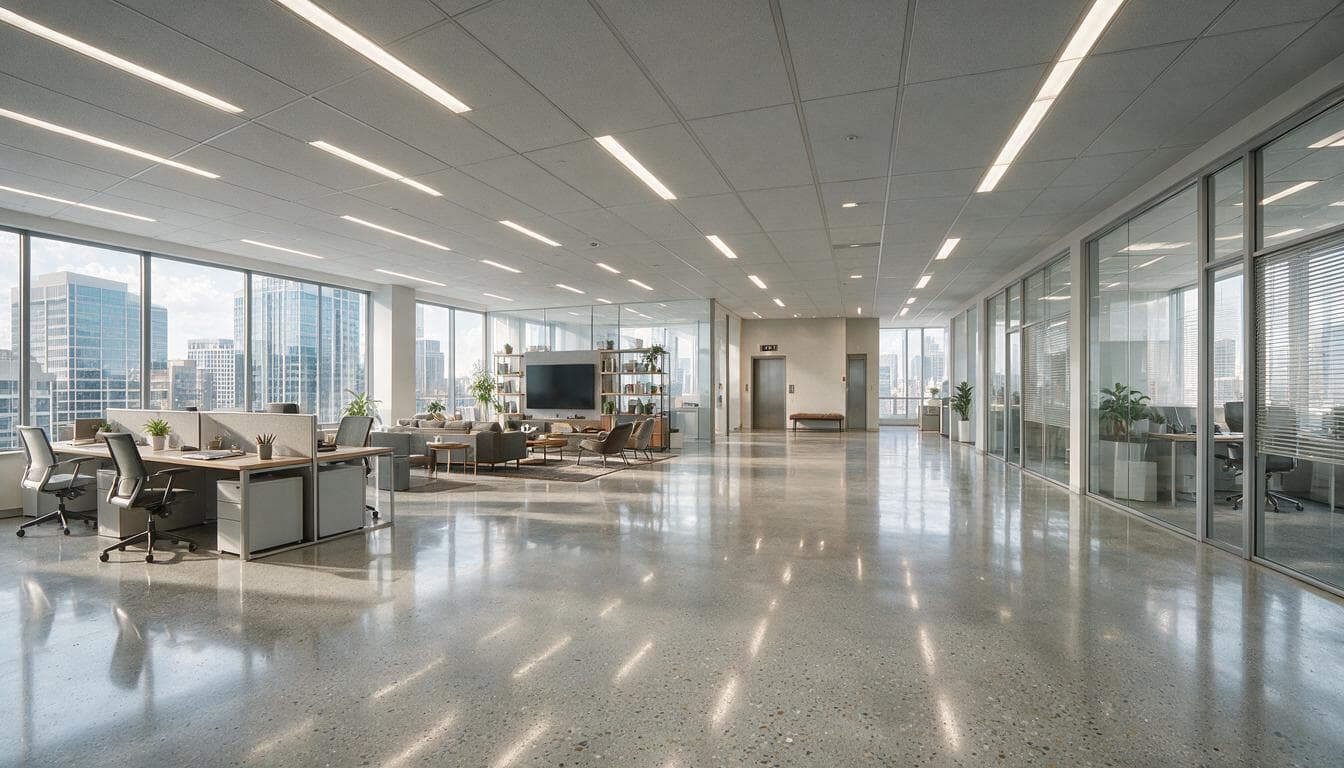
Polished WinsPermanent floor, no replacement cycle, reflects merchandise and architectural lighting, and suits the open-plan aesthetics of Charlotte's South End and Uptown commercial spaces. Long-term cost over a 20-year building lifespan is lower than epoxy that requires periodic topcoat refreshing.
Commercial flooring →Warehouses, Restaurants, Kennels, and Commercial Kitchens
Epoxy WinsChemical resistance, anti-slip aggregate, and the ability to coat drains and coved bases are all epoxy advantages in high-demand commercial environments. Quartz broadcast and urethane cement systems in particular are specified for food service, veterinary, and industrial facilities precisely because they create seamless, chemical-resistant surfaces that polished concrete cannot match without additional coatings applied on top.
Warehouse flooring →Cost Comparison — Charlotte 2026
Epoxy — Installed Cost
Typical Charlotte Garage (450 sqft)
Polished Concrete — Installed Cost
Typical Charlotte Projects
10-Year Cost Comparison — Commercial Retail, 1,000 sqft
Flake epoxy: $5,000 install + topcoat refresh at year 7 ($1,500) = $6,500 over 10 years
Polished concrete: $10,000 install + sealer at year 3 and 6 ($400 each) = $10,800 over 10 years
At year 15, polished concrete pulls ahead — the floor never needs reinstalling.
Frequently Asked Questions
Not Sure Which System Is Right for Your Charlotte Space?
Free on-site estimates for both epoxy and polished concrete. We assess your slab, use case, and budget — then give you an honest recommendation before any work is scoped.