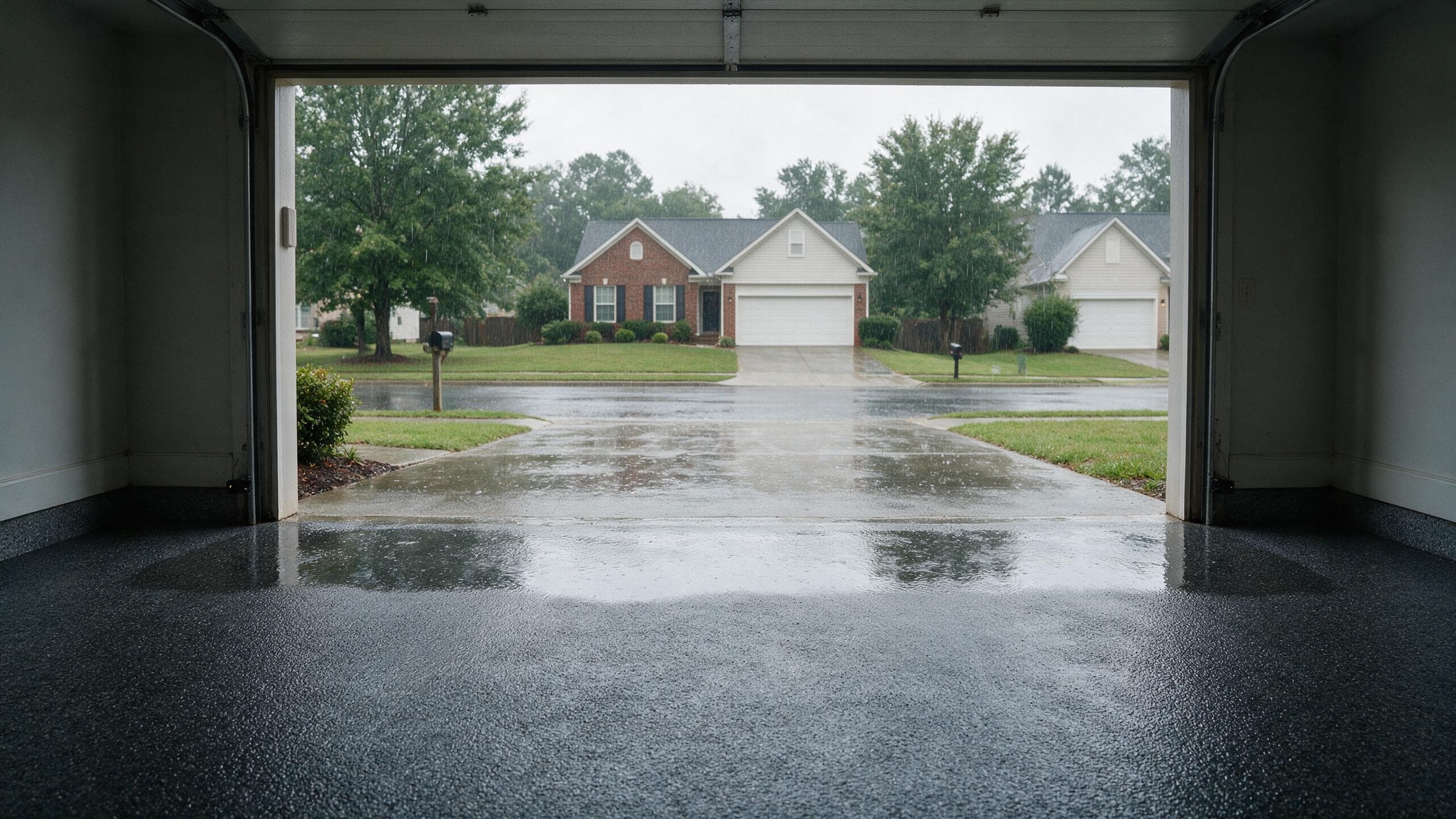
Dry, no. A coated floor grips about as well as sealed concrete and better than polished concrete or tile. Wet, it can be, particularly at high gloss with no texture. That is a specification choice rather than a property of epoxy: broadcasting anti-slip aggregate into the topcoat costs $0.25–0.75 per square foot and settles the issue. A flake system already carries useful texture on its own.
Anti-Slip Options and What They Cost
| Option | Texture | Added Cost | Best For |
|---|---|---|---|
| No additive, smooth topcoat | Smooth | Included | Dry interior, display space |
| Decorative flake broadcast | Light profile | Included in flake systems | Residential garages |
| Fine aluminium oxide | Fine grit | +$0.25–0.50/sqft | Garages, basements, entries |
| Medium polymer grit | Moderate | +$0.35–0.60/sqft | Commercial, wet-prone areas |
| Coarse silica sand | Aggressive | +$0.40–0.75/sqft | Ramps, pool decks, kitchens |
Aggregate is broadcast into the final clear coat so the grains sit at the wear surface. Adding it later means recoating, so it is a decision to make before the topcoat goes down.
Five Things That Change Traction
Water, not the coating
A dry coated floor is not a slip risk in any normal residential setting. Introduce a film of water and the picture changes on any hard surface, coated or not. In Charlotte the specific scenarios are rain blowing through an open garage door, snowmelt dripping off a vehicle in January, and condensation on a cool slab during a humid morning.
Gloss level, which is mostly perception plus a little reality
High gloss reads as slippery before anyone steps on it, and that instinct is not entirely wrong: a very smooth film has less micro-texture for a shoe sole to key into. Dropping to a satin topcoat improves wet traction slightly and changes the look considerably. It is not a substitute for aggregate where water is a real presence.
What is on your feet
Soft rubber soles grip a wet coated floor far better than smooth leather or worn work boots. This sounds obvious and it is routinely the actual variable in a fall. It is also why a floor that feels fine to the installer in work boots can feel slick to someone in dress shoes.
Oil and fluid, which beat texture
Anti-slip aggregate helps considerably with water and much less with oil, because oil fills the profile between grains rather than being displaced by it. In a workshop or auto bay the answer is a coarser profile plus a drip mat under the vehicle, not aggregate alone.
Slope, which nobody checks
Many Charlotte garage slabs are poured with a deliberate fall toward the door for drainage. That slope is invisible underfoot when dry and becomes relevant the moment the surface is wet. On a noticeably sloped slab we specify aggregate as a matter of course rather than as an option.
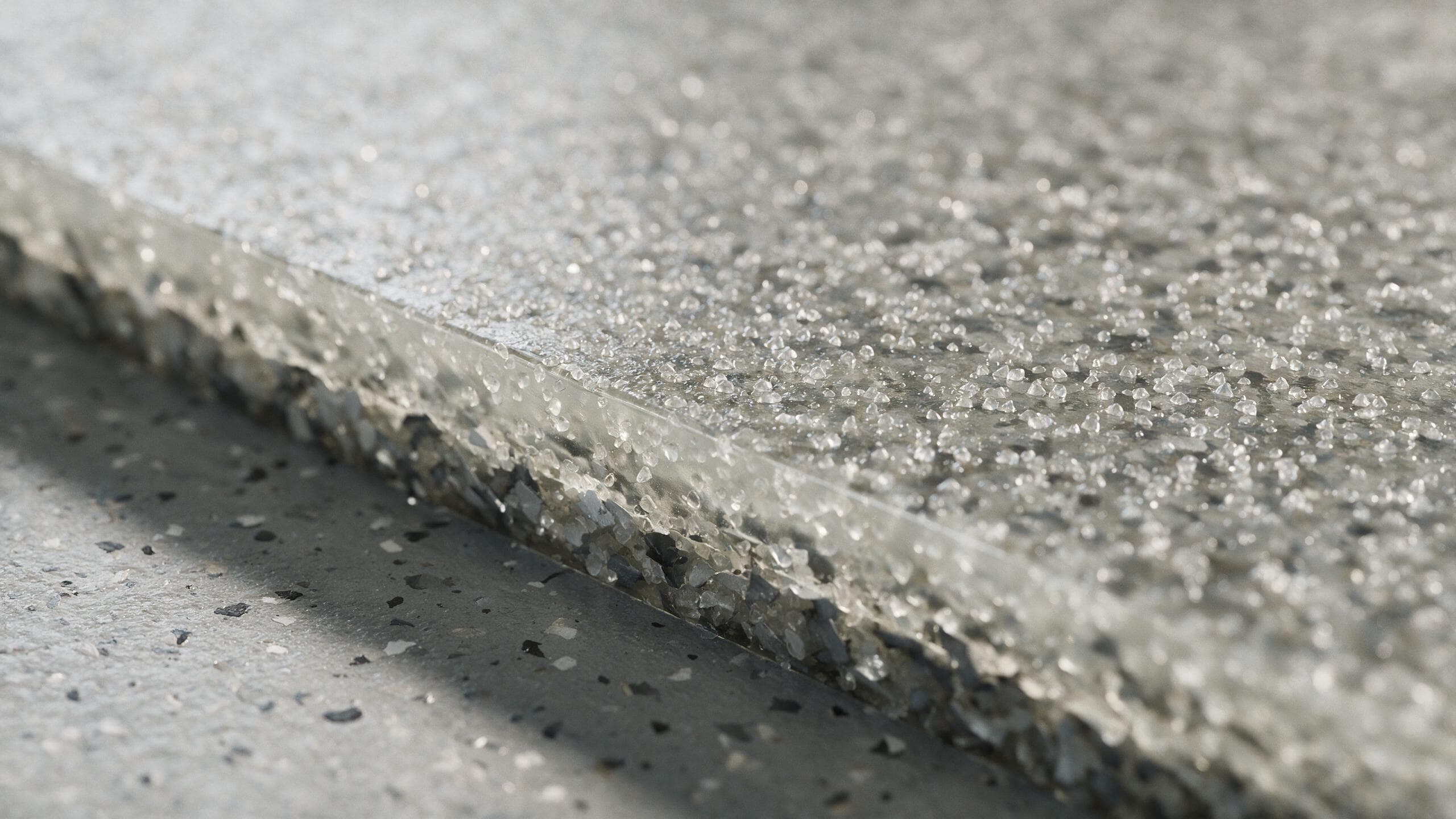
Aluminium oxide suspended in the clear coat. The grains are what a shoe sole keys into once the surface is wet
Where We Would Actually Add It
On a standard Charlotte residential garage with a full flake broadcast, we usually do not add aggregate across the whole floor. The flake already provides a usable profile, and a fully gritted garage is harder to sweep for a risk that mostly lives in the first few feet by the door.
What we do more often is zone it. Aggregate in the apron band inside the door where rain blows in and vehicles drip, smooth through the rest of the floor. You get traction exactly where water arrives and easy cleaning everywhere else. The transition is not visible once the topcoat cures.
Full-floor aggregate is the right call on pool decks, on any sloped ramp, in basements with a sump or a history of moisture, and in commercial space that gets mopped on a schedule. In a commercial kitchen it is not optional, and the grade goes coarser than anything we would put in a house.
Worried about a wet floor at the door line, a sloped slab, or a pool deck? Tell us the room and we will specify the grade that fits rather than the most aggressive one. Free across the Charlotte metro.
Get Free EstimateFrequently Asked Questions
Related Guides
Share this guide: