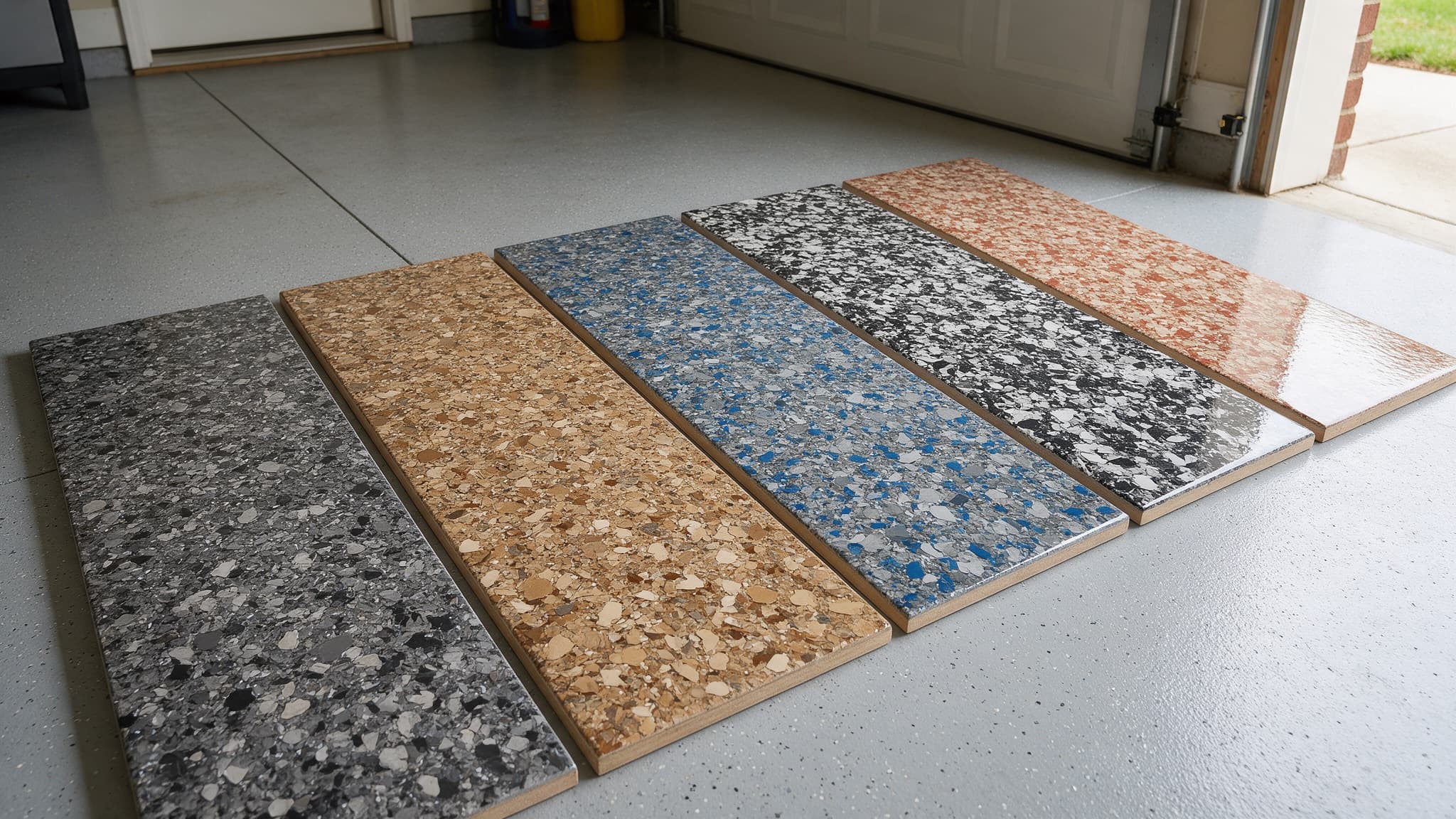
Pick a mid-tone blend with high internal contrast. Charcoal and grey is the Charlotte default for good reasons: it hides Piedmont clay dust, it conceals topcoat ambering, and it works against local brick. Colour costs nothing extra at $5–8 per square foot for a flake system. The decision that actually costs you is choosing a light or cool blend without a UV stable topcoat over it.
How the Common Blends Actually Perform
| Blend | Hides Dirt | What It Shows | Best For |
|---|---|---|---|
| Charcoal and grey | Excellent | Water spots if very dark | The Charlotte default |
| Tan and brown | Excellent | Little | Garages open to a finished interior |
| Blue and grey | Good | Ambering, if epoxy topcoat | Workshops, a deliberate accent |
| Black and white | Moderate | Dust on the black, marks on the white | High contrast, showroom look |
| Terracotta and beige | Good | Little | Matching brick or Spanish tile |
| Single-tone light grey | Poor | Everything | Clean rooms, rarely a garage |
All stock blends price the same. Custom colour matching is the only blend choice that changes the number.
Five Things That Decide Whether You Still Like It in Year Eight
Contrast does the hiding, not darkness
People assume a dark floor hides dirt. It does not. A flat dark floor shows dust and dried water spots as pale marks. What hides debris is internal contrast: several chip tones in one blend, so your eye reads texture and stops resolving individual specks. The best performing garage floors we install are mid-tone and busy, not dark and uniform.
Chip size changes the read more than colour
The same colour mix at 1/4 inch chip looks like a speckled solid surface. At 1 inch it looks like stone. Most Charlotte residential garages get a 1/4 inch blend, which is forgiving and consistent. Larger chips make a stronger statement and show broadcast unevenness more clearly, so they demand a crew that keeps a consistent throw across the whole floor.
Match the door line, not the paint chip
Garage colour decisions get made indoors under warm light, then the floor lives under daylight pouring through an open door. Take any sample outside and look at it in direct sun before committing. Blues and greys in particular shift noticeably between a showroom fluorescent and a Charlotte afternoon.
Light blends punish a non UV stable topcoat
Ambering from an epoxy topcoat shifts a floor toward yellow. On charcoal you will never see it. On light grey, white, or blue it is obvious within a few years, and it arrives first as a band across the front of the garage where daylight reaches. If you want a cool or light blend, a UV stable polyaspartic topcoat stops being optional.
Full broadcast or partial changes the look entirely
A full broadcast to refusal covers the base coat completely, so you see only flake. A partial broadcast lets base colour show through between chips, which reads softer and uses less material. Neither is wrong, but they are different floors, and a quote that does not say which one you are getting is not a complete quote.
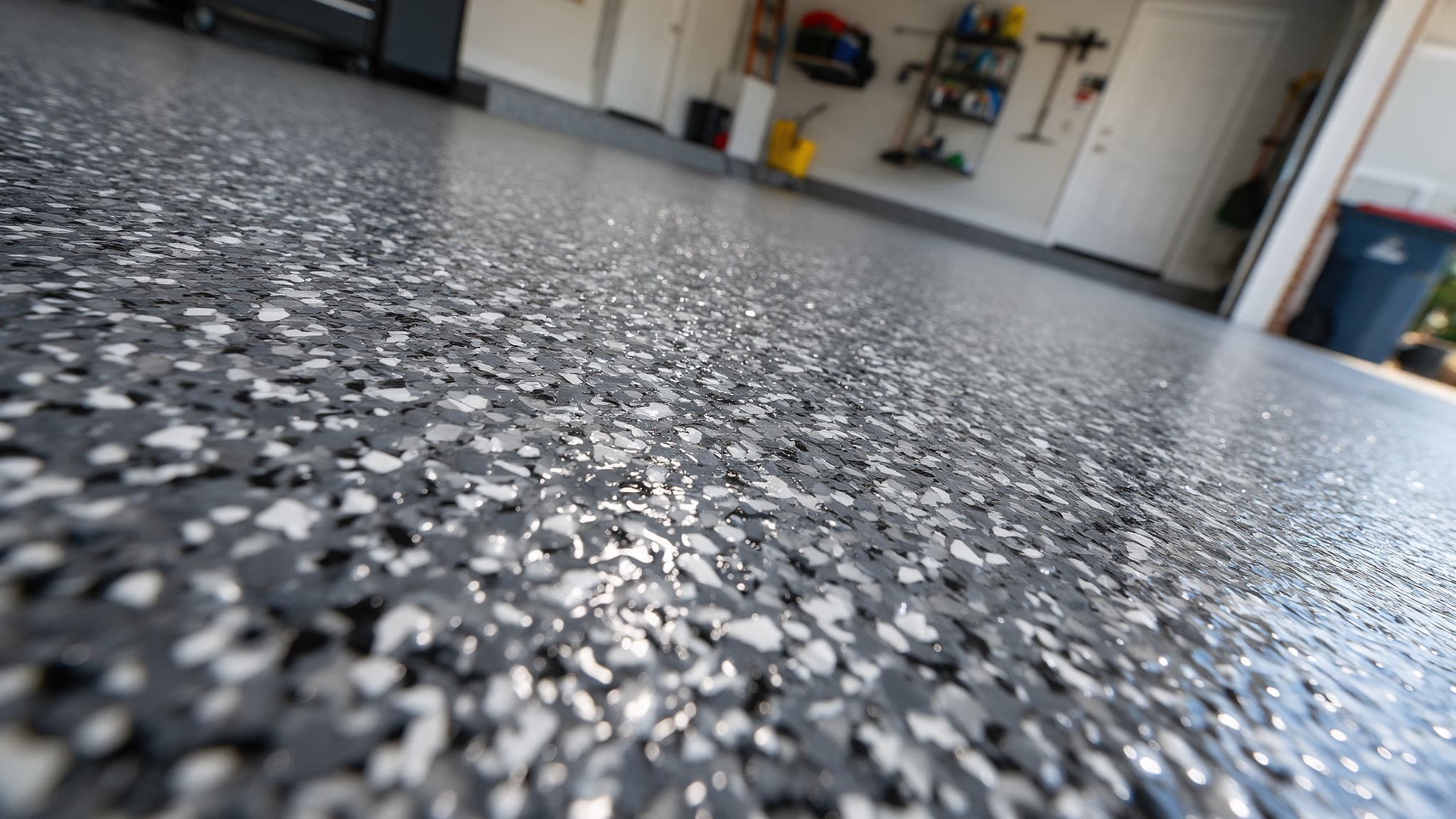
Up close, the chips are discrete. At standing height they blend into a single texture, which is the whole mechanism behind hiding dirt
How to Actually Choose
Get physical samples, put them on the garage floor, and open the door. Not a brochure, not a screen. A blend photographed under studio light has almost no relationship to the same blend under a Charlotte afternoon, and the garage is the only room in the house that routinely gets direct outdoor light across its entire floor.
Then stand up. Flake blends are chosen at arm's length and lived with from six feet, and the two views are genuinely different: a mix that looks busy in your hand usually settles into a calm texture underfoot, while a mix that looks subtle in your hand can read as flat and featureless across a whole bay.
Last, decide what the floor is next to. If the garage opens into a finished basement or mudroom, the floor wants to relate to that interior rather than compete with it, which is why tan and brown blends get chosen more often in those houses than the charcoal that dominates everywhere else.
We bring physical sample panels to the estimate and lay them on your floor with the door open, because that is the only view that predicts how you will feel about the colour in year five. Free across the Charlotte metro.
Get Free EstimateFrequently Asked Questions
Related Guides
Share this guide: