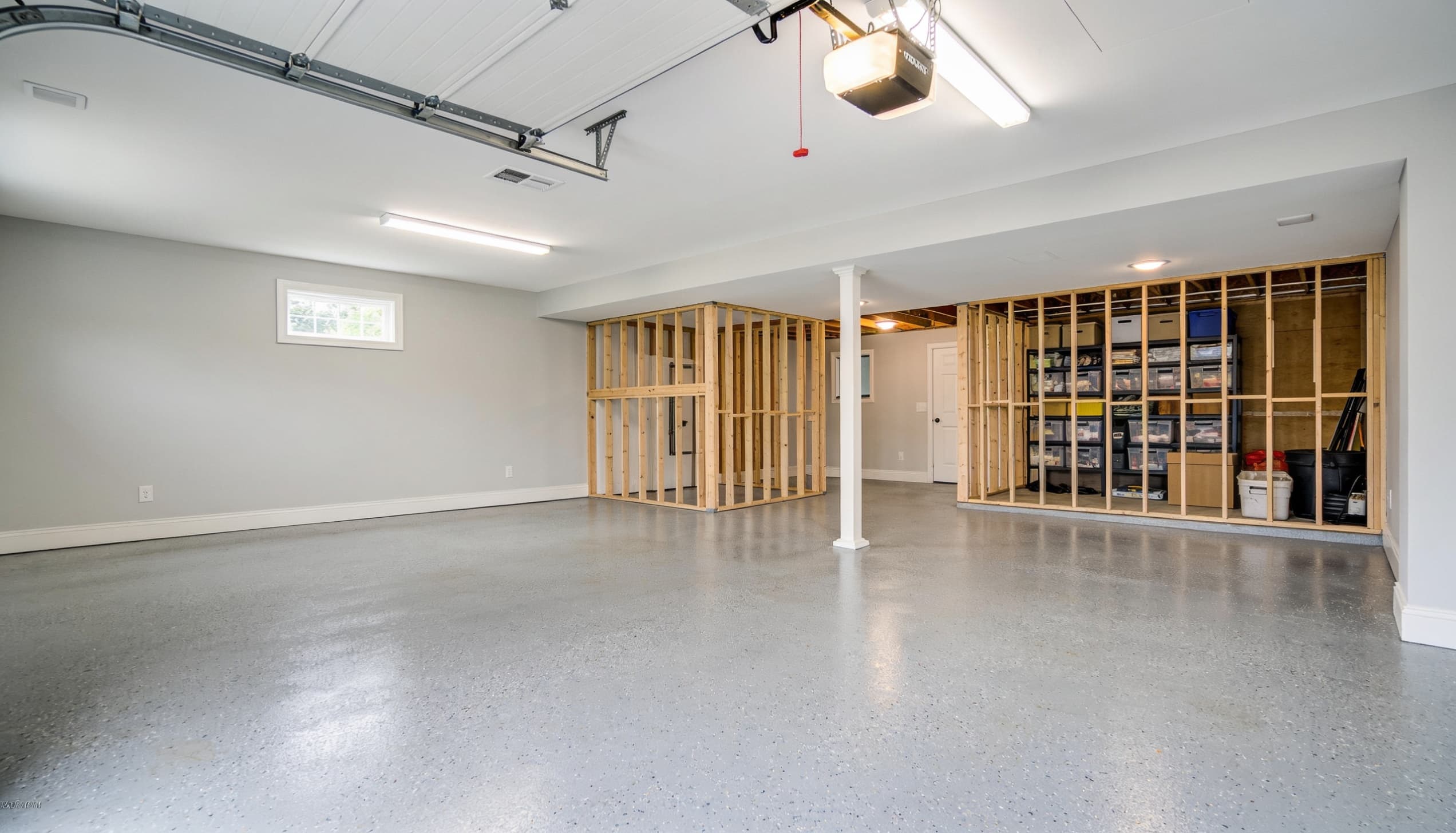
Basement floor coating in Charlotte costs $4–$8 per square foot installed. A typical 800 sqft basement runs $3,600–$6,400. The single biggest variable is not the finish you choose — it is whether the slab needs moisture mitigation, which adds $0.50–$0.75/sqft and is required more often in Charlotte than most homeowners expect. Full breakdown by system, size, and slab condition below.
Basement Floor Coating Cost by System — Charlotte 2026
| System | Cost/sqft | Lifespan | Best For |
|---|---|---|---|
| Solid colour epoxy | $4–$6 | 8–12 yrs | Utility basements, storage, mechanical rooms |
| Flake epoxy (partial broadcast) | $4.50–$6.50 | 10–15 yrs | Budget-conscious finished space |
| Full flake + polyaspartic top | $5–$8 | 10–15 yrs | Most Charlotte finished basements |
| Polyaspartic 1-day | $7–$12 | 15–20 yrs | Occupied homes needing fast turnaround |
| Metallic epoxy | $9–$12 | 10–15 yrs | Basement bars, theatre rooms, feature floors |
| Polished concrete | $4–$10 | Permanent | Modern finished basements, no coating to replace |
All prices USD installed, includes diamond grinding, crack repair, base coat, and topcoat. Moisture-mitigating primer priced separately at $0.50–$0.75/sqft. Charlotte minimum project $1,400.
What It Costs by Basement Size
| Basement | Area | Installed Range |
|---|---|---|
| Small basement / bonus room | ~400 sqft | $1,600–$3,200 |
| Typical Charlotte basement | ~800 sqft | $3,600–$6,400 |
| Large finished basement | ~1,200 sqft | $5,400–$9,600 |
| Full walk-out basement | ~1,800 sqft | $7,200–$14,400 |
Larger areas cost less per square foot — mobilisation and setup are fixed costs spread across the job.
The Moisture Question — Why Charlotte Basements Are Different
This is the section that matters more than the price table. A basement floor coating does not fail because someone chose the wrong colour. It fails because water vapour moved up through the slab and pushed the coating off from underneath, and nobody tested for it first.
Charlotte sits on Piedmont clay. Clay holds water rather than draining it, which means that after a wet spring the soil against your foundation stays saturated for weeks. That water finds the path of least resistance, and on a below-grade slab, that path is up through the concrete. The concrete does not have to be visibly wet for this to be happening — vapour transmission is invisible right up until a coating starts blistering.
The other Charlotte-specific factor is age. Vapour retarders under residential slabs only became routine practice in the region in the 1990s. Basements in Dilworth, Myers Park, Plaza Midwood, and the older parts of Elizabeth were frequently poured directly onto gravel or bare soil. Those slabs are permanently connected to ground moisture, and no amount of surface drying changes that.
How we test before quoting
We use in-situ relative humidity probes drilled into the slab, following the ASTM F2170 method — the same standard the flooring industry uses before installing moisture-sensitive materials. The probes sit for 24 hours and give a reading of the actual humidity inside the concrete, not just at its surface. Under roughly 75% RH is a straightforward install. Between 75% and 85% we specify a moisture-mitigating primer. Above 85% the mitigation is mandatory and we will say so plainly.
A moisture-mitigating epoxy primer costs $0.50–$0.75 per square foot — on an 800 sqft basement, $400–$600. Compare that to the cost of grinding a blistered floor off and starting again eighteen months later, which is the entire original price plus removal, and the maths is not close.
Signs your Charlotte basement slab has a moisture issue
White powdery deposits on the slab
Efflorescence — mineral salts left behind as water moves through the concrete and evaporates. A direct sign of vapour transmission.
Dark patches that come and go
The slab is wetting and drying seasonally. Common in Charlotte after the spring rain cycle.
Carpet or pad that smells musty
Moisture is reaching the underside of the flooring. Coating the slab will not fix the source but stops the material that holds the odour.
Previous flooring that lifted or curled
Failed adhesive on old tile or LVP is one of the strongest indicators of vapour drive we can see without testing.
Plastic sheet taped down goes cloudy
The old ASTM D4263 field check. Crude, but if a taped-down plastic square fogs overnight, get a proper RH test before coating.
One thing a coating cannot do: stop active water intrusion. If water is entering through a wall crack, a failed sump, or poor exterior grading, that has to be fixed before any floor goes down. A coating is a vapour management system, not a waterproofing system, and any contractor who tells you otherwise is selling you a floor that will fail.
What's Included in the Charlotte Basement Coating Price
Slab moisture testing
In-situ relative humidity probes per ASTM F2170, or a calcium chloride test where appropriate. This is the step that decides whether a moisture-mitigating primer is required. We do it before quoting, not after starting.
Diamond grinding
Mechanical profiling of the slab to open the pore structure so the coating bonds. Removes laitance, old adhesive from tile or carpet tack strip, and previous sealers. Charlotte basements frequently have carpet glue residue that has to come off entirely.
Crack and spall repair
Cracks are chased out, vacuumed, and filled with a rigid polyurea. Spalled and pitted areas are patched and re-ground flush. Included on most quotes; extensive damage is priced separately.
Primer coat
Standard epoxy primer on dry slabs; a moisture-mitigating epoxy where RH readings call for it. This layer is what stands between vapour drive and your finished floor.
Base coat and chip broadcast
100% solids epoxy base with vinyl chips broadcast to refusal on flake systems. Excess chip is scraped back and vacuumed the next day.
Topcoat
Clear polyurethane or polyaspartic. Determines abrasion resistance, chemical resistance, and how easy the floor is to clean. Included in every quoted price.
What Drives a Basement Quote Up or Down
↑ Moisture mitigation required
Adds $0.50–$0.75/sqft. The most common cost adder in Charlotte basements.
↑ Carpet tack strip and adhesive
Old carpet glue and tile mastic must be ground off entirely. Adds grinding passes and tooling wear.
↑ Extensive cracking or spalling
Heavy repair work is priced above the standard allowance included in most quotes.
↑ Tight access or stair-only entry
Equipment has to be carried down. Adds crew hours on both ends of the job.
↑ Cove base at the walls
$8–$12 per linear foot. Worth it in basements where you want a sealed, cleanable wall-to-floor transition.
↓ Post-1995 slab with vapour retarder
Usually tests dry. Skips mitigation entirely and prep is fast.
↓ Bare, unfinished slab
Nothing to demolish or grind off. The cheapest starting condition there is.
↓ Larger open area
Fewer cut-ins and edges. Cost per square foot drops as area grows.
Charlotte Basement Project Costs — Real Numbers
Dilworth 1940s basement
650 sqft · Full flake + polyaspartic, moisture primer
Slab tested at 88% RH — no vapour retarder under a 1940s pour. Moisture-mitigating primer added $0.65/sqft and made the difference between a floor that lasts and one that blisters.
“It had smelled like a basement for forty years. It does not anymore.”
Huntersville new-build basement
1,100 sqft · Full flake + polyaspartic
Modern slab with an intact vapour retarder, tested at 71% RH. No mitigation needed, clean prep, finished in two days.
Matthews basement home gym
480 sqft · Solid colour epoxy with anti-slip additive
Utility finish chosen deliberately — the owner wanted a floor that took dropped weights and wiped clean, not a showpiece.
Ballantyne basement bar and theatre
900 sqft · Metallic epoxy feature area + flake in service space
Metallic across the bar and lounge, flake in the storage and mechanical area, split at a clean transition line. Two finishes, one install.
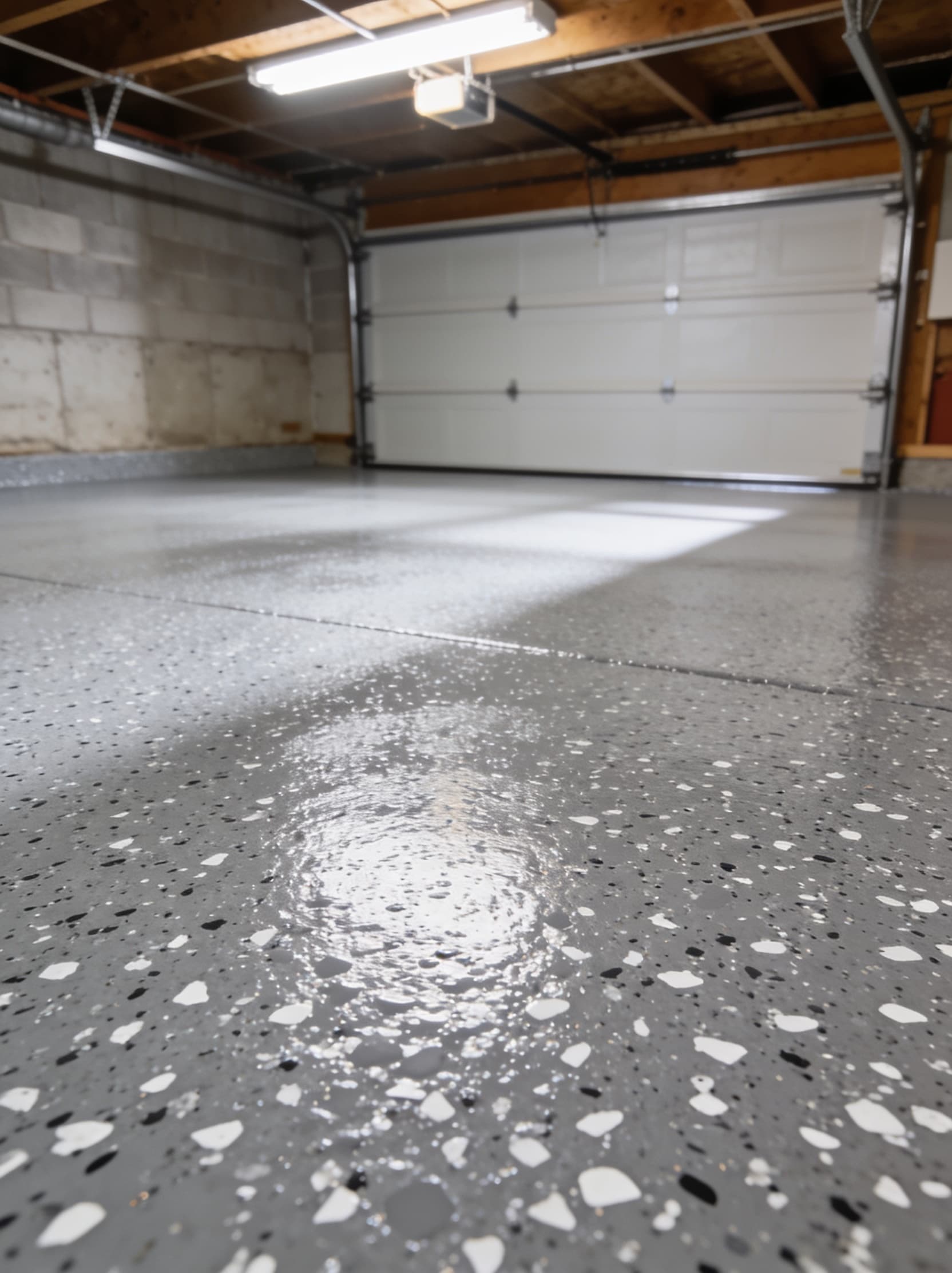
A finished flake surface up close — sealed edge to edge, with no grout lines or seams for moisture to sit in
Coating vs Carpet vs LVP in a Charlotte Basement
Ten-year outlook on an 800 sqft finished basement:
Carpet + pad
Install: $3,200–$5,600
Replace after water event or ~8 yrs
10-yr: $6,400–$11,200
LVP floating floor
Install: $4,000–$7,200
Often lifted to dry after intrusion
10-yr: $4,000–$11,200
Epoxy / polyaspartic
Install: $3,600–$6,400
Mop after water event
10-yr: $3,600–$6,400
The comparison is not really about upfront price — all three land in a similar band. It is about what happens the one time a Charlotte basement takes water. Carpet and pad come out. Floating floors often come up to dry the slab underneath. A coated slab gets squeegeed and mopped, and the floor is unaffected. For a below-grade space in a climate with wet springs, that difference is the whole argument.
How Long the Install Takes
Two days is standard. Day one covers grinding, repairs, primer, and the base coat with chip broadcast. Day two is scrape-back, vacuum, and topcoat. Light foot traffic is generally fine the evening of day two; furniture goes back after 24–72 hours depending on the topcoat. If the slab needs a moisture-mitigating primer, add a half day for cure time before the base coat.
Basements are usually easier to schedule than garages because the space is climate-controlled — we are not fighting Charlotte's July humidity or a January cold snap, both of which affect cure windows on an uninsulated garage slab. If you need the space back the same day, the polyaspartic system does it, at a higher cost per square foot.
Free on-site basement assessment across the Charlotte metro — including slab moisture testing before we quote, not after we start. You get a fixed price and an honest read on whether your slab needs mitigation.
Get Free EstimateFrequently Asked Questions
Related Guides
Share this guide: